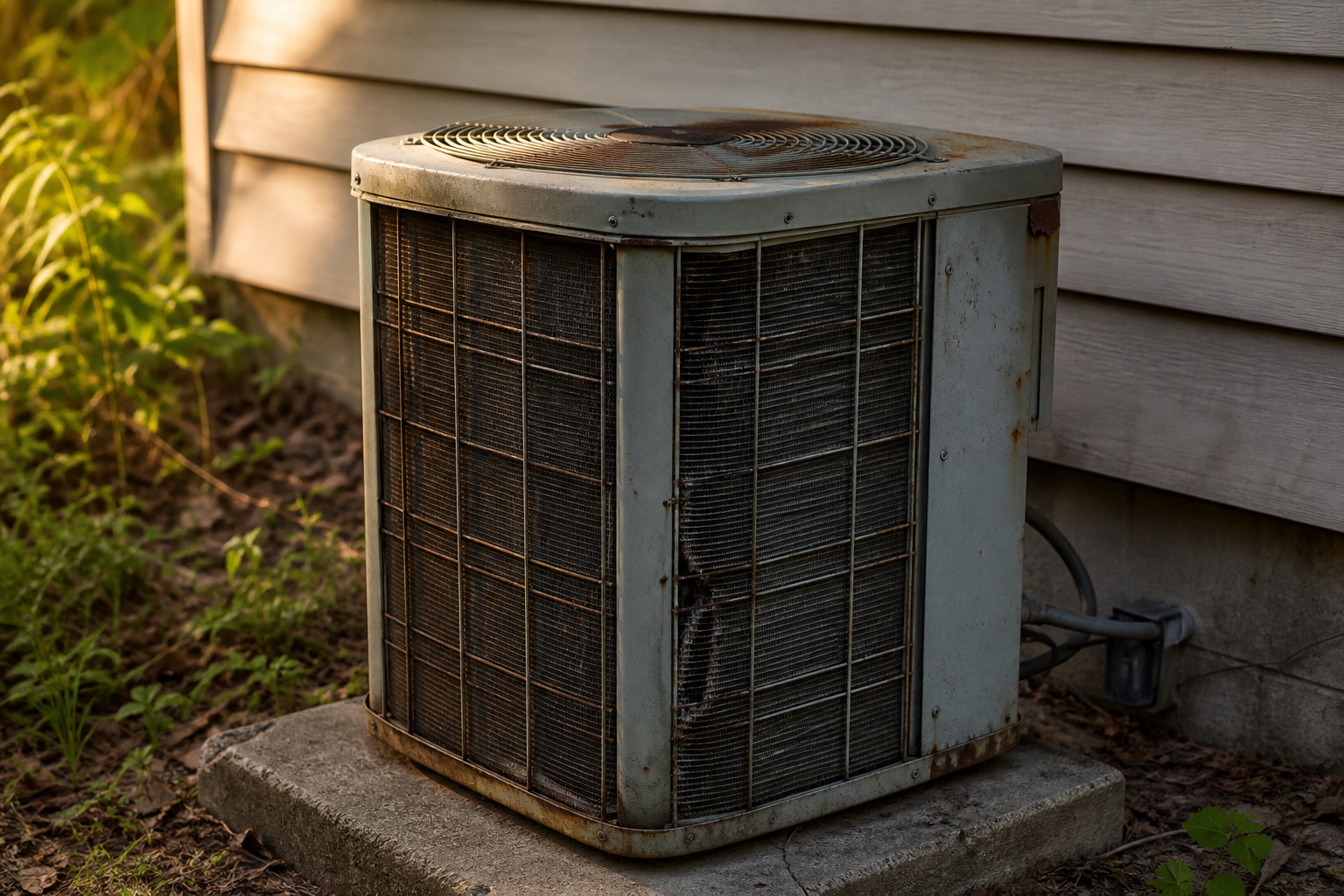
Denver’s intense UV exposure, wide temperature swings, and thinner air all put more stress on AC components than lower-altitude climates.
Your AC is 11 years old and running fine — but last summer it needed a capacitor. The summer before that, a contactor. Now you’re staring down another hot season wondering: is this thing on borrowed time, or is it worth putting money into? And how long should you realistically expect an AC to last at 5,280 feet?
These are the exact questions I help Denver homeowners work through every spring. I’ve replaced hundreds of systems at Blue Collar Heating & Air over the past 20+ years, and I’ve watched the same patterns repeat: homeowners who pump $800 into a 14-year-old unit, only to have the compressor die six months later. And homeowners who replace a perfectly repairable 9-year-old system because a salesperson scared them. This guide gives you the honest numbers — national averages, Denver reality, and a straightforward decision framework.
⚡ Quick Answer: How Long Does AC Last in Denver?
- Nationally: AC units average 15–20 years of service life.
- In Denver: Expect 10–15 years due to altitude-related stress.
- Why Denver ages ACs faster: 20–30% more UV exposure (degrades capacitors, wiring, control boards), 15% thinner air (compressor works harder), and dramatic temperature swings from -5°F to 100°F that cause thermal expansion/contraction stress year-round.
- Repair or replace rule: If your Denver AC is 12+ years old and needs a $500+ repair, replacement is almost always the smarter investment. If it’s under 10 years old and the repair is under $500, repair it.
National Average vs. Denver Reality
The HVAC industry’s standard answer to “how long does an AC last?” is 15–20 years. That’s accurate — for sea-level, moderate-climate markets. In Denver, that number shrinks. Based on hundreds of replacements over 20+ years servicing the Front Range, the realistic range is 10–15 years, with the median closer to 12–13 years for typical homeowners.
Here’s what makes Denver specifically hard on air conditioning equipment:
300+ Days of Sunshine — UV Degradation
Denver averages 300+ sunny days per year, and at 5,280 feet, UV radiation is 20–30% more intense than at sea level. This matters for AC equipment because UV relentlessly degrades the polymer materials, wiring insulation, control board coatings, and capacitor dielectric materials in your outdoor condenser unit. Components that are rated for 10 years at sea level routinely fail at 5–7 years in Denver. This is why we replace so many capacitors on relatively young systems here — it’s not a manufacturing defect; it’s altitude.
Denver’s UV Effect on AC Components
At 5,280 feet, UV radiation is 20–30% more intense than at sea level. Capacitors rated for 10 years of service life in lower-altitude markets typically fail at 5–7 years in Denver. This is the most common “premature” component failure we see.
Average capacitor lifespan in Denver (vs. 10 years nationally)
Thinner Air — Compressor Workload
At 5,280 feet, air is approximately 15% less dense than at sea level. Your AC compressor moves refrigerant by compressing a gas — and thinner air means less thermal mass to work with, requiring the compressor to cycle more and work harder to achieve the same cooling effect. Compressors are the most expensive component in an AC system ($800–$2,000 for the part alone), and accelerated wear at altitude is a real factor in Denver’s shorter average system life.
Temperature Swings — Thermal Stress
Denver’s climate is famous for its volatility: temperatures can swing 40–50°F in a single day during spring and fall. These dramatic swings cause the metal components, refrigerant lines, electrical connections, and cabinet materials in your system to expand and contract repeatedly. Over years, this thermal cycling fatigues solder joints, cracks drain pans, loosens fittings, and causes contactors to wear faster. It’s the same reason Denver roads need more frequent pothole repair than cities with more stable climates.

UV-degraded capacitor (left) vs. new. Capacitor failure is the most common service call on Denver ACs aged 5–10 years — altitude accelerates the process.
8 Signs Your Denver AC Is Approaching End of Life
None of these signs alone means you need a new system today — but each one shifts the math toward replacement. The more of these that apply to your unit, the more seriously you should consider budgeting for a new system rather than continuing to repair.
Age: 12+ Years in Denver (10+ for R-22 Systems)
At 12 years in Denver (roughly equivalent to 15 years in a lower-altitude market), your system has consumed the majority of its reliable service life. If yours uses R-22 refrigerant (discontinued in 2020), the threshold is even lower — 10+ years is end-of-life territory because of refrigerant availability and cost issues.
Frequent Repairs: 2+ Calls in 3 Years, or One $500+ Repair
A single capacitor replacement ($175–$250) is a normal maintenance event. Two or more service calls in three years — or one repair exceeding $500 — signals systemic wear. Each repair buys progressively less time as surrounding components share the same age profile.
Using R-22 Refrigerant (Phased Out Since 2020)
R-22 (HCFC-22) was phased out under EPA regulations and is no longer manufactured. If your outdoor unit label says R-22, the refrigerant now costs $50–$150 per pound (vs. $8–$15/lb for modern R-410A). A simple refrigerant top-off on an older system can cost $400–$800 just for the refrigerant alone — and it still doesn’t fix the underlying leak.
Energy Bills 15–20% Higher Than 5 Years Ago
As compressors wear, they draw more electricity to achieve the same cooling. If your summer electricity bills have crept up 15–20% or more despite similar usage patterns and Xcel Energy rate changes accounted for, your system is losing efficiency. A new high-efficiency system (18+ SEER) can cut summer cooling costs by 30–40%.
Inconsistent Cooling: Some Rooms Hot, Others Cold
When the compressor begins losing capacity, the system can no longer maintain consistent temperature throughout the house. The rooms farthest from the air handler or at the end of duct runs become notably warmer than the thermostat setting. This isn’t a duct issue — it’s a capacity issue indicating compressor wear.
Constant Running: Unit Runs All Day, Can’t Hit Target Temp
An AC that runs continuously on a 95°F Denver summer day without reaching the set temperature is undersized for the load, has severely degraded efficiency, or both. On days above 95°F, a little extra run time is normal. Running all day when it’s 85°F is not — that’s a system that’s out of capacity.
Loud Noises: Grinding, Banging, or Squealing
Grinding usually indicates compressor bearing wear — which means compressor failure is approaching. Banging can mean loose parts inside the compressor or a broken mounting bracket. Squealing often indicates a failing fan motor bearing. Any of these sounds in a 10+ year old Denver system points toward end-of-life rather than a simple repair.
Rust or Corrosion on Cabinet, Fins, or Refrigerant Lines
Visible rust on the outdoor condenser cabinet, bent or corroded aluminum fins, or corrosion on refrigerant line connections indicates years of weather exposure without adequate maintenance. Corroded fins reduce heat transfer efficiency; corroded refrigerant connections develop slow leaks. Cosmetic rust alone isn’t a replacement trigger — but combined with age and other signs, it confirms the system is in its final years.
⚠️ If Your AC Uses R-22 Refrigerant
Check the label on your outdoor condenser unit. If it says “R-22” or “HCFC-22,” plan to replace the system when the next significant repair comes — regardless of age. R-22 refrigerant is nearly impossible to source affordably. A refrigerant recharge that would cost $100–$200 on a modern R-410A system can cost $800–$2,000 or more on an R-22 system. Put that repair money toward a new system instead.
The Repair vs. Replace Decision
There’s a practical formula used across the HVAC industry called the $5,000 Rule. It provides a quick framework for the repair/replace decision:
The $5,000 Rule
Unit Age × Repair Cost = Decision Number
If the result exceeds $5,000, replacement is the smarter investment. If it’s under $5,000, repair. For Denver, I apply an adjustment: subtract 2 years from the unit’s actual age to account for altitude accelerating the wear cycle. A Denver AC that’s 12 years old should be treated like a 14-year-old unit in the formula.
Real Examples
| Scenario | Calculation | Verdict |
|---|---|---|
| 8-year-old unit, $400 repair (capacitor + contactor) | 8 × $400 = $3,200 | Repair |
| 14-year-old unit, $600 repair (TXV valve) | 14 × $600 = $8,400 | Replace |
| 11-year-old unit, $450 repair (capacitor + refrigerant top-off) | 11 × $450 = $4,950 | Gray zone — lean repair if well-maintained |
| 12-year-old unit, $800 repair (evaporator coil) | 12 × $800 = $9,600 | Replace |
| 9-year-old unit, $350 repair (contactor + tune-up) | 9 × $350 = $3,150 | Repair |
The formula isn’t infallible — maintenance history matters. A meticulously maintained 13-year-old unit with clean coils, fresh capacitors, and no refrigerant issues may have more life in it than the formula suggests. A neglected 9-year-old that’s never been serviced and has run with dirty coils for three years is a worse bet than it looks. Use the formula as a starting point, not an absolute answer.
What Kills Denver AC Units Early
Some systems make it to 15+ years in Denver. Others die at 8 or 9. The difference is almost always one of these factors — most of which are in the homeowner’s control.
Skipping Annual Maintenance
The single biggest predictor of early AC failure is deferred maintenance. Annual tune-ups catch capacitors before they fail (a failing capacitor strains the compressor), clean coils that have accumulated efficiency-killing buildup, verify refrigerant pressure, and check for developing leaks. Skipping maintenance doesn’t save money — it just moves the cost to a larger, less predictable failure later.
Running with a Clogged Filter
A clogged air filter restricts airflow over the evaporator coil, which causes the coil to freeze, which causes the compressor to work against backpressure, which accelerates compressor wear. It’s a slow death measured in years, not days — but it’s real. We’ve documented compressor failures in 9–10 year old Denver units that show internal wear consistent with years of restricted airflow. A $15 filter change every 60 days protects a $4,000–$8,000 system.
Cottonwood Clogging Outdoor Coils
Denver’s cottonwood season (late May through mid-June) is brutal on outdoor condenser coils. Cottonwood fibers accumulate on the coil fins, reducing airflow across the condenser. A restricted condenser coil forces the system to run hotter, stressing the compressor and reducing efficiency. Rinse the coil with a garden hose monthly during cottonwood season — spray from inside out to avoid pushing debris deeper into the fins.
Power Surges from Summer Thunderstorms
Denver’s summer thunderstorm pattern is severe and frequent. A direct or near-miss lightning strike can send voltage spikes that instantly destroy control boards, start capacitors, and compressor windings. A whole-system HVAC surge protector ($150–$250 installed) is the most cost-effective insurance policy for your AC investment — particularly for high-efficiency systems with sophisticated control boards that can cost $500–$900 to replace.
Undersized System Running Constantly
Previous homeowners sometimes install AC systems sized for sea-level cooling loads — or simply chose an undersized unit to save money. An undersized system runs essentially non-stop during hot Denver summers, accumulating wear at an accelerated rate. Hours of operation matter more than years of age for compressor life.
A Broomfield Homeowner’s $4,800 Lesson
Last spring, a Broomfield homeowner called us after his 9-year-old Carrier system failed completely — compressor seized. He was frustrated; the system “shouldn’t be dead yet.” When we inspected it, the evaporator and condenser coils were nearly black with debris. The filter hadn’t been changed in years. The refrigerant had been slowly leaking (the coil showed significant ice damage), and the last maintenance record we could find was from three years prior.
The compressor had been running against a frozen coil, with restricted airflow, for years. It accumulated wear that would normally take 15+ years in under 10. Annual maintenance — roughly $90–$120 per year — would almost certainly have caught each of these issues and kept that system running for another 5–6 years. The replacement cost was $6,800. The math on skipped maintenance is brutal.
How to Extend Your AC’s Life in Denver
You can’t defeat altitude — but you can manage the factors within your control. These habits consistently separate the Denver systems that last 14–15 years from those that die at 8–9.
- Annual tune-up every April or May — before cooling season begins. A trained technician will clean the coils, check capacitor condition (and replace before failure), verify refrigerant pressure, inspect the drain pan and line, and test electrical connections. This is the single highest-ROI maintenance activity you can do. Cost: $90–$140.
- Change the filter every 60 days during cooling season — set a phone reminder. If you have pets, multiple occupants, or live near a busy road, bump it to 30 days. In Denver’s dry winter, every 90 days is usually sufficient.
- Rinse the outdoor coils monthly during cottonwood season (May–June) — use a garden hose with a gentle stream, spraying from inside the coil outward. Do not use a pressure washer, which can bend the delicate aluminum fins.
- Install an HVAC surge protector ($150–$250 installed) — protects the compressor windings and control board from thunderstorm voltage spikes. Pays for itself after one storm that would have fried a $700 control board.
- Keep plants, grass, and mulch at least 2 feet back from all sides of the outdoor unit — restricted airflow around the condenser coil raises operating temperatures and accelerates compressor wear.
- Don’t close more than 20% of your home’s supply vents — closing vents increases static pressure in the duct system, reducing airflow across the evaporator coil and stressing the blower motor and compressor.
- Keep the outdoor unit level — the pad your condenser sits on can settle over time in Colorado’s clay soil. A tilted unit causes uneven compressor lubrication. Check it every few years and re-level if needed.
New AC Cost in Denver — What to Budget When It’s Time
When the math says it’s time to replace, here’s what you should budget in the current Denver market. These are installed prices — equipment plus labor — for a standard split-system replacement (outdoor condenser + indoor coil, no furnace). Ductwork modifications, electrical upgrades, or permit requirements can add cost.
$4,500–$6,500
$5,500–$8,000
$7,000–$12,000
Add $1,500–$3,000
✓ Xcel Energy Rebates Available
Xcel Energy offers rebates of $100–$500 for high-efficiency AC replacement in Colorado, depending on the SEER rating of the new equipment. We handle the paperwork. These rebates stack with any manufacturer promotions — ask us about current offers when you call.
For a full breakdown of what goes into new AC pricing — brands, SEER ratings, labor factors, and how to avoid overpaying — see our detailed guide: How Much Does a New AC Cost in Denver?

Modern 16–18 SEER systems use significantly less electricity than systems installed 12+ years ago, often recovering the replacement cost through energy savings within 5–8 years.
Ready to Fix Your HVAC Issue?
Call Blue Collar Heating & Air for expert service in the Denver Metro area. Same-day appointments available.
Frequently Asked Questions
Check the manufacturer’s label on the outdoor condenser unit — it’s usually a silver sticker on the side or back of the cabinet. The serial number encodes the manufacture date, but the format varies by brand:
- Carrier and Bryant: The 5th and 6th digits of the serial number are the year (e.g., “F2026” indicates 2026).
- Trane and American Standard: The 2nd through 5th digits encode the year and week of manufacture.
- Lennox: The first four digits of the serial number encode the year and week.
- York and Coleman: The first letter indicates the year in a 25-year cycle.
Or just call us — we can pull the manufacture date instantly from the model and serial number. (303) 351-1667.
Probably not for anything over $400. At 15 years in Denver — equivalent to roughly 18–20 years in a lower-altitude market — you’re near or past the end of reliable service life. The compressor, coil, and control systems are all aging simultaneously. A repair that costs $500 today might buy 12–18 months before the next component fails. Put that money toward a new system instead, or at minimum, get a quote on replacement so you can compare total cost of ownership. We’ll always give you both numbers honestly.
It depends on your furnace’s age and condition. Here’s a practical rule:
- If your furnace is 15+ years old and you’re replacing the AC, replace both. You’ll save $500–$1,000 in labor since technicians are already on-site with equipment staged, and matched systems communicate more efficiently, improving comfort and reducing energy use.
- If your furnace is 5–10 years old and in good condition, replace just the AC. There’s no need to accelerate the furnace retirement.
Note: when replacing only the outdoor condenser, we strongly recommend also replacing the indoor evaporator coil. Mismatched old/new coil and condenser combinations reduce efficiency and can void warranty coverage.
Trane and Carrier consistently rank among the most durable in industry reliability surveys. That said, maintenance history matters far more than brand for actual lifespan. A well-maintained mid-range Lennox will reliably outlast a neglected top-of-line Trane.
At Blue Collar, we install Carrier, Lennox, and York depending on application and budget. We don’t have a financial stake in pushing any specific brand — we’ll recommend what’s right for your home’s load, ductwork, and budget. Call us at (303) 351-1667 to discuss what makes sense for your situation.
Yes — demonstrably. At 5,280 feet, thinner air means the compressor works harder to move refrigerant. UV is 20–30% more intense, degrading capacitors, wiring insulation, and control board materials faster. Dramatic temperature swings (Denver regularly sees 40°F daily swings in fall and spring) create more thermal expansion/contraction stress on all system components. In 20+ years of replacing systems across the Denver metro, I consistently see ACs failing and needing replacement at 10–13 years — versus 15–18 years for comparable systems in lower-altitude markets like Phoenix, Dallas, or Kansas City.
Northglenn • Thornton • Westminster • Broomfield • Brighton • Firestone • Dacono • Arvada