
Denver is one of the driest major cities in America — and most homeowners don’t fully realize what that means until winter hits. When you’re running your furnace all day and night, the indoor relative humidity in a typical Denver home can drop to 5–15%. That’s not just uncomfortable. That’s drier than the Sahara Desert, which averages around 25% relative humidity. If you’re waking up with bloody noses, your lips are cracked by November, you’re getting a static shock every time you touch a doorknob, or your beautiful hardwood floors are starting to separate at the seams — your home is telling you it needs a whole-home humidifier.
After 20+ years installing and servicing HVAC systems across the Denver metro, a whole-home humidifier is one of the most-recommended add-ons I suggest to homeowners — particularly in older homes and those with hardwood floors or wood furniture. The cost is modest relative to the damage dry air causes, and the comfort improvement is immediate. This guide walks you through everything you need to know: how dry Denver actually gets, how to tell if you need one, which type to choose, and what it costs installed.
✅ Quick Answer
Yes — most Denver homes genuinely benefit from a whole-home humidifier. Denver’s winter outdoor humidity runs 15–25%, and when you heat that cold outdoor air inside your home, indoor relative humidity drops to 5–15%. The ASHRAE-recommended range for indoor comfort and health is 35–50%. A whole-home humidifier installed on your furnace automatically maintains proper humidity levels — protecting your health, your wood flooring and furniture, and your HVAC equipment itself.
Installed cost: $400–$700 for a bypass humidifier | $550–$900 for a fan-powered model | $800–$1,500 for a steam humidifier.
How Dry Is Denver? (The Real Numbers)
Denver’s reputation as a “sunny, dry city” understates just how extreme the dryness gets in winter, especially indoors. The physics of heating cold outdoor air are working against you: when you pull in outdoor air at 20°F with 20% relative humidity and heat it to 70°F indoors, that same air — because warmer air holds far more moisture — now sits at just 3–5% relative humidity. You haven’t removed any moisture. You’ve just made the air’s capacity for moisture much larger, so the percentage plummets.
Here’s how Denver’s winter humidity compares to what most people think of as “dry”:
- Denver average winter outdoor RH: 15–30%
- Denver average indoor RH (heating without humidifier): 5–15%
- Sahara Desert average RH: ~25%
- Phoenix, AZ average winter RH: ~30%
- ASHRAE recommended indoor RH: 30–50%
Denver’s Winter Indoor Humidity Without a Humidifier
Indoor relative humidity in Denver homes running a furnace without supplemental humidification. The Sahara Desert averages 25%. The ASHRAE comfort standard is 30–50%.
The gap between where Denver homes actually sit (5–15%) and where they should be (35–50%) is enormous. It’s why HVAC professionals consistently name whole-home humidification as one of the highest-value comfort improvements for Denver homeowners. The good news: fixing it is straightforward and not expensive.

Signs Your Denver Home Needs a Humidifier
Your home and your body both show symptoms of insufficient humidity long before the damage becomes severe. Here are the most common signs I hear from Denver homeowners when I arrive for a service call:
- Frequent nosebleeds — dry mucous membranes crack and bleed, especially in children
- Chapped lips throughout winter even when indoors — not just when you’re outside in wind and cold
- Static shock from doorknobs, light switches, and other people — electric charge that builds up in dry air
- Morning sore throat or dry cough that improves once you leave the house — your respiratory tract is drying out overnight
- Wood floors separating at seams or cupping — hardwood contracts in extreme dryness, creating visible gaps
- Wood furniture cracking, splitting, or finishes checking — antiques and solid wood pieces are especially vulnerable
- Paint cracking on walls — particularly on older painted trim or exterior-facing walls
- Increased respiratory infections through the winter — dry air dries out the mucous membranes that trap and filter pathogens
- Higher heating bills than expected — dry air feels colder; you turn the thermostat up, but humid air at 68°F feels as warm as 72°F dry air
- Plants drying out faster than normal — not just you — your plants are losing moisture rapidly too
If you’re experiencing three or more of these, a whole-home humidifier will make a noticeable difference within the first week of operation. Most homeowners notice improved sleep, fewer morning symptoms, and reduced static within days of installation.
Types of Whole-Home Humidifiers
There are three main categories of whole-home humidifiers, each with different operating principles, costs, and best-fit applications. Here’s an honest breakdown of each from someone who installs all three:
Bypass Humidifier (Most Common for Denver Homes)
$400–$700 Installed
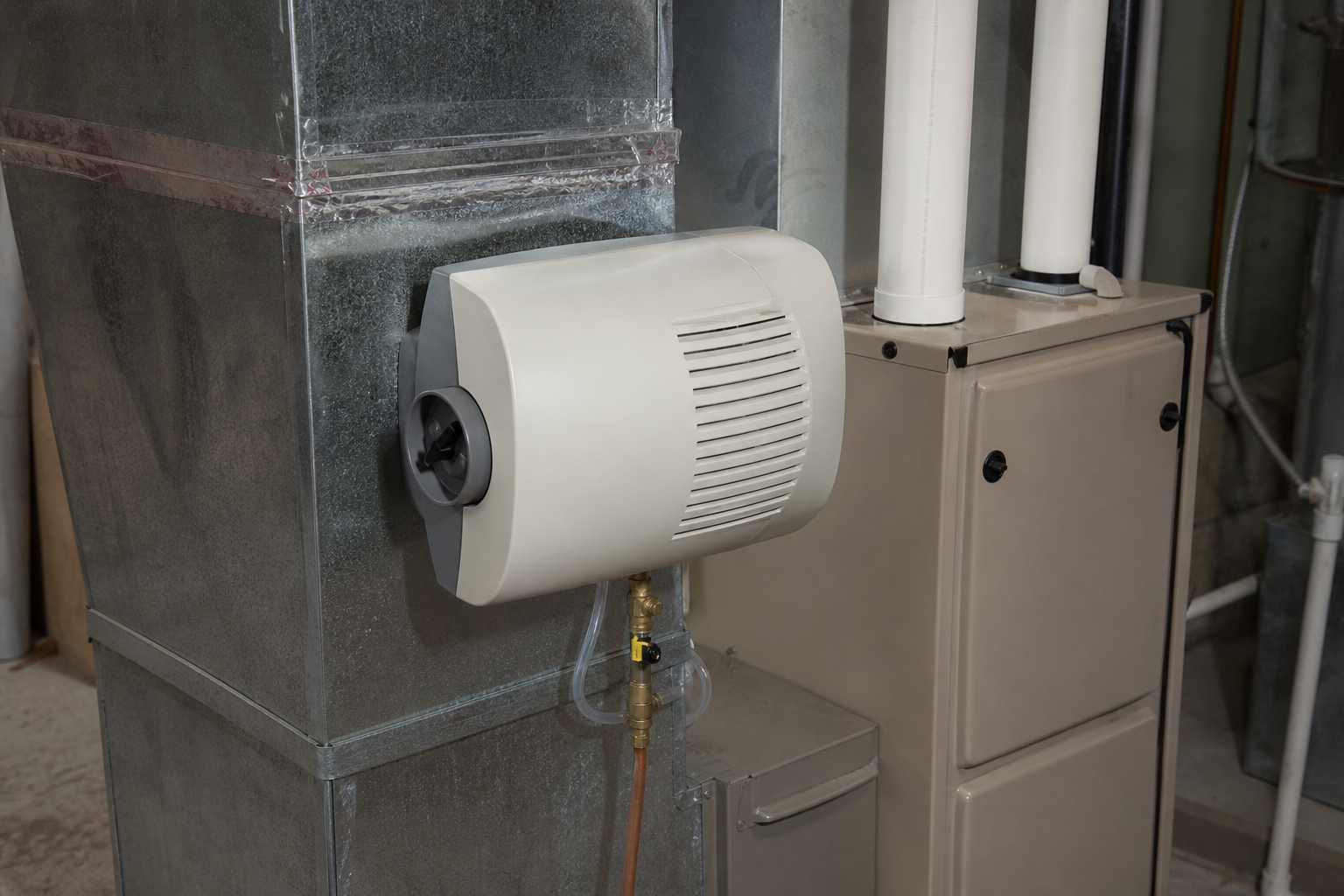
A bypass humidifier taps into your supply duct and passes warm air across a water-saturated evaporator pad (also called a water panel or vapor pad). The moistened air is then returned to the return duct and distributed throughout the home. The unit only operates when your furnace is running — which in Denver winters, is most of the day.
Popular models: Aprilaire 600, Honeywell HE360
Best for: Standard forced-air gas furnaces — which describes the vast majority of Denver-area homes. If your home has central ductwork and a gas furnace (and it probably does), this is almost certainly the right choice.
✅ Pros
- Lowest installed cost
- Simple, reliable design
- Minimal moving parts
- Easy annual maintenance
❌ Cons
- Only runs with furnace on
- Less precise humidity control
- Annual pad replacement needed
Annual maintenance: Replace the evaporator pad each fall (about $25 for the pad, 15 minutes of your time, or part of our annual tune-up service).
Fan-Powered Humidifier
$550–$900 Installed
A fan-powered humidifier operates similarly to a bypass unit but includes its own fan to push air across the evaporator pad. This means it can add moisture to the air even when the furnace blower isn’t running — a useful feature for homes with zone systems, heat pumps, or situations where the furnace cycles infrequently.
Popular model: Aprilaire 700
Best for: Homes with zoned HVAC systems, heat pumps, or homes in very dry microclimates where maximum moisture output is needed without depending on furnace run time.
✅ Pros
- Runs independently of furnace
- Higher moisture output
- Better for zone systems
❌ Cons
- Higher cost than bypass
- Slightly more complexity
- Marginally higher energy use
Steam Humidifier
$800–$1,500 Installed
A steam humidifier uses electric heating elements to boil water, injecting pure steam directly into the ductwork. It produces the most moisture of any whole-home type and operates completely independently of your furnace — making it suitable for very large homes, tight construction, or applications where extremely precise humidity control matters (home recording studios, wine rooms, art storage, etc.).
Popular models: Aprilaire 800, Honeywell HM750A
Best for: Homes larger than 3,500 sq ft, very well-insulated new construction, or homeowners with specific precision humidity requirements.
✅ Pros
- Maximum moisture output
- Most precise control
- Works independent of furnace
- Sterile steam (kills bacteria)
❌ Cons
- Highest upfront cost
- Uses more electricity
- More complex maintenance
- Overkill for most Denver homes
Denver note: Most Denver homes under 3,500 sq ft don’t need a steam humidifier. A bypass or fan-powered unit handles the load comfortably and saves you $400–$800 in upfront costs. I only recommend steam when a customer has a very large or unusually tight home.
7 Days a Week · 6 AM – 9 PM · Serving Northglenn, Thornton, Westminster & More
What It Does for Your Home (Beyond Comfort)
The comfort benefits of proper humidity are obvious — you feel better, sleep better, and stop shocking yourself on every metal surface. But the protection a humidifier provides to your home’s structure and systems is actually where the real value lies, especially in a Denver home where dryness is severe and prolonged.
Protects Wood Floors and Furniture
Hardwood flooring and solid wood furniture are engineered with a moisture content of around 6–9%. When indoor humidity drops to 5–15% for months at a time, wood loses moisture, contracts, and eventually cracks or separates at seams. Denver hardwood floor damage from chronic low humidity can cost $3,000–$10,000+ to repair or replace — a cost far exceeding a decade of humidifier operation.
Saves on Heating Costs
Humid air feels warmer than dry air at the same temperature. This is basic thermodynamics: water vapor carries heat more effectively than dry air. At proper humidity (35–45%), most people are comfortable at 68°F rather than needing to push the thermostat to 72°F. That 4°F difference represents roughly 3–5% in heating cost savings — not huge, but a real benefit on top of everything else.
Protects Your HVAC System
Dry air promotes static electricity buildup. Modern HVAC systems — especially those with variable-speed ECM motors, communicating thermostats, and digital control boards — are sensitive to electrostatic discharge. Excessive static from extremely dry air can contribute to premature failure of control boards and sensors. Proper humidity is a simple, passive form of protection for expensive electronics in your system.
Supports Respiratory Health
Mucous membranes in your nose, throat, and lungs are your body’s first line of defense against airborne pathogens. When those membranes dry out, they crack and lose effectiveness — making you more susceptible to colds, flu, and upper respiratory infections. Maintaining 35–45% RH supports proper mucous membrane function throughout the winter heating season.
📋 Real Job Story: Westminster Hardwood Floor Rescue
A Westminster homeowner called me after noticing significant gaps opening between her 15-year-old oak hardwood planks every winter. She’d already had a flooring company attempt repairs twice — sanding and refinishing to close gaps — but they returned each fall. The underlying problem was a furnace running full-time with no humidification.
We installed an Aprilaire 600 bypass humidifier for $590 all-in. The following winter, the floor gaps didn’t reopen. She estimated she’d spent $4,500 on floor repairs over the previous three winters before solving the actual root cause. The humidifier paid for itself many times over — and continues protecting floors that are now 18 years old.
Installation — What to Expect
Installing a bypass or fan-powered whole-home humidifier is a half-day job for an experienced HVAC technician. Here’s exactly what the process involves so you know what to expect on installation day:
- Total installation time: 2–4 hours for a bypass or fan-powered unit
- Duct tap: We cut an opening in the supply duct and mount the humidifier body with sheet metal screws and foil tape
- Bypass duct: A small flexible duct runs from the humidifier to the return duct to complete the airflow loop
- Water line: We tap into the nearest cold water supply line (usually 1/4″ copper or saddle valve connection)
- Wiring: Low-voltage wiring connects the humidifier to the furnace control board and the humidistat (the dial you use to set your target humidity level)
- Humidistat placement: Typically mounted on the return duct or on a wall near your thermostat for easy access
- Test and calibrate: We run the furnace and verify the unit is producing humidity, check for water leaks, and set the humidistat to an appropriate starting level for the season
Annual Maintenance: Each fall before heating season, the evaporator pad (water panel) should be replaced. It costs about $25 for the panel and takes 15 minutes. Over the summer, mineral deposits from Denver’s moderately hard water clog the pad and reduce efficiency. We replace it as part of our annual furnace tune-up — or we can show you how to do it yourself if you prefer.
No floor drain is needed for bypass or fan-powered models — the water evaporates entirely into the air. Steam units do require a drain connection. Most Denver homes have gas furnaces and central ductwork already, making bypass humidifier installation very straightforward without any significant disruption to your system.

How Much Does a Whole-Home Humidifier Cost in Denver?
Here are current installed prices for the most common whole-home humidifier models we install in the Denver metro. “Installed” means parts, labor, water line, wiring, and humidistat — everything needed to have a working system.
| Model | Type | Installed Cost |
|---|---|---|
| Aprilaire 600 | Bypass (most popular) | $400–$650 |
| Honeywell HE360 | Bypass | $450–$700 |
| Aprilaire 700 | Fan-Powered | $550–$850 |
| Aprilaire 800 | Steam | $900–$1,400 |
| Honeywell HM750A | Steam | $950–$1,500 |
| DIY bypass unit (no installation) | Equipment only | $150–$400 |
Blue Collar Guarantee: All humidifier installations include a 1-year manufacturer parts warranty plus our own workmanship guarantee. If anything we touched causes a problem in the first year, we fix it at no charge. We also include a complimentary first-season water panel check at your next furnace tune-up.
For most Denver homeowners choosing between options, the Aprilaire 600 is the sweet spot — reliable, simple, well-supported, and priced so that it pays for itself in energy savings and wood protection within 1–3 heating seasons depending on your situation.
Ready to Fix Your HVAC Issue?
Call Blue Collar Heating & Air for expert service in the Denver Metro area. Same-day appointments available.
Frequently Asked Questions
Open 7 Days a Week · 6 AM – 9 PM · No Extra Charge for Weekends