
In This Article
Most homeowners “shut down” their AC by simply not touching the thermostat anymore once fall arrives. That’s not wrong, exactly, but it skips a few steps that protect your outdoor unit through a Denver winter — one that can include heavy snow, freeze-thaw cycles, and months of total inactivity. Here’s the proper way to do it.
⚡ Quick Answer: AC Shutdown Checklist
Why a Proper Shutdown Matters in Denver
Your outdoor AC condenser is built to handle outdoor conditions year-round, so it’s not fragile — but Denver throws a few specific challenges at it that make a bit of fall attention worthwhile. Heavy, wet snow can accumulate on top of the unit and, during freeze-thaw cycles, work its way into the cabinet. Debris left against the coils over winter attracts rodents looking for a warm, sheltered spot, and mice chewing through low-voltage control wiring is a surprisingly common spring repair call.
The Correct Shutdown Steps
1. Final Cleaning
Hose down the condenser coils (the fins around the sides of the unit) to remove any accumulated dust, cottonwood fluff, or grass clippings. A clean unit going into winter means less debris trapped under snow and ice.
2. Clear the Area
Trim back any plants or shrubs to maintain at least 2 feet of clearance on all sides. This matters even more in winter — snow shoveled or blown off a driveway often gets piled near the unit, and you want clear ground so that pile doesn’t bury the whole condenser.
3. Decide on a Cover
This is the most debated step — more on it below.
4. Leave the Breaker On (Usually)
Many homeowners assume they should flip the breaker off to “save power” over winter. In most modern systems, we actually recommend leaving it on. Many compressors have a small internal crankcase heater that keeps oil warm and prevents refrigerant from pooling in the compressor during cold weather — cutting power to this heater can cause compressor damage when you start the system back up in spring. If you’re unsure whether your system has one, leaving the breaker on is the safer default.
5. Don’t Disconnect Anything
There’s no need to disconnect refrigerant lines, electrical connections, or anything else. Your AC system is a sealed, weatherproof unit designed to sit outside through winter without being “unplugged” in any meaningful sense.
Should You Cover Your Outdoor AC Unit?
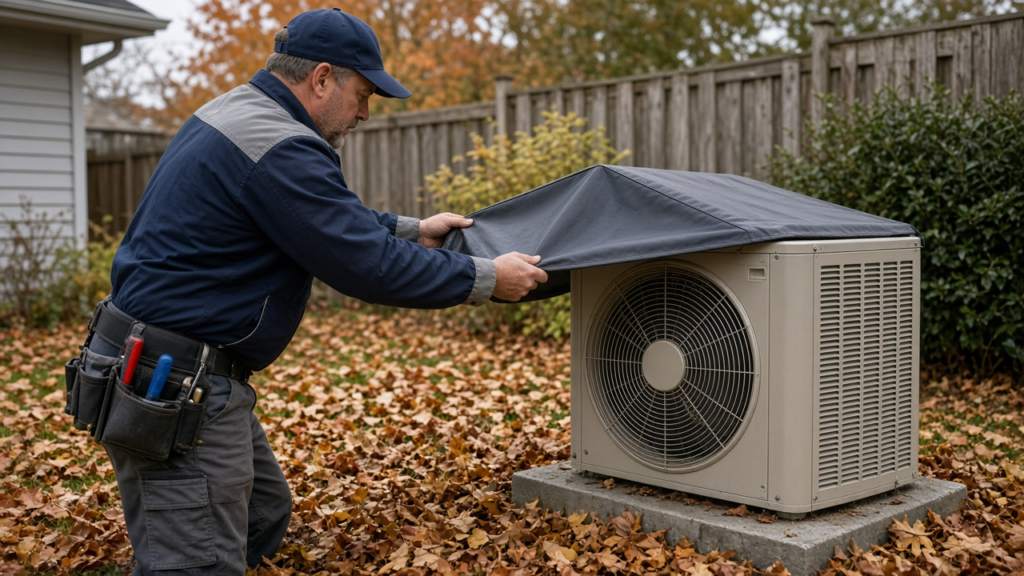
This is genuinely the most common question we get every October, and the honest answer is: a partial top cover, yes; a full wrap, no.
A better approach, if you want some protection, is a flat top cover that shields just the top of the unit from falling debris and heavy snow accumulation while leaving the sides open for airflow. Several manufacturers sell purpose-built top covers for $20-$40 that do exactly this without trapping moisture.
Common Shutdown Mistakes to Avoid
Real Job: Arvada, Spring 2025
A homeowner in Arvada had fully wrapped their AC unit in a plastic tarp every winter for years “to protect it.” When we came out for a spring start-up check, we found significant rust on the internal fan motor housing and evidence that mice had been nesting inside — they’d chewed through the low-voltage thermostat wire. The repair, including a new contactor and rewiring the control circuit, ran about $380. We switched them to a simple top-only cover, and the following winter showed no issues.