✓ Licensed & Insured ✓ 20+ Years Experience ✓ Same-Day Service ✓ Family Owned

Why Fall Is the Best Time to Schedule HVAC Maintenance in Denver

📖 Table of Contents ▾

In This Article

  1. Quick Answer
  2. The Scheduling Advantage
  3. Catching Problems Before They’re Emergencies
  4. Does Timing Affect Pricing?
  5. What Gets Missed When You Wait
  6. FAQ

Written by Lance Fredrickson — ICC Certified HVAC Specialist | EPA 608 Universal

20+ years serving the Denver metro • Blue Collar Heating & Air, Northglenn CO

Every HVAC company will tell you fall is a good time for maintenance, and it can sound like a sales pitch. But there’s real, practical reasoning behind it that has nothing to do with upselling you — it’s about availability, diagnosis quality, and avoiding the exact week everyone else in Denver also needs help.

⚡ Quick Answer: Why Fall Works Best

Scheduling flexibility — Pick your preferred day/timeHigh in fall
Mid-winter scheduling — Often 1-2 week wait during cold snapsLow flexibility
Time to order parts — If an issue is foundDays, not hours
Emergency no-heat call cost — vs. scheduled fall visitOften higher

The Scheduling Advantage

HVAC demand is seasonal and predictable, which means fall (specifically September and early October) is a genuine lull between AC season ending and heating season demand peaking. Appointment availability during this window is at its best all year — you can typically get a convenient same-week appointment, choose a specific time window, and avoid the rush.

Compare that to the first genuinely cold snap of the year, usually sometime in November, when every HVAC company in the metro gets flooded with no-heat calls simultaneously. Wait times for a non-emergency tune-up during that window can stretch 1-2 weeks, and even emergency no-heat calls get prioritized by severity, meaning a “my furnace is a little weak” call waits behind a “my furnace won’t turn on at all and it’s 15°F” call.

Catching Problems Before They’re Emergencies

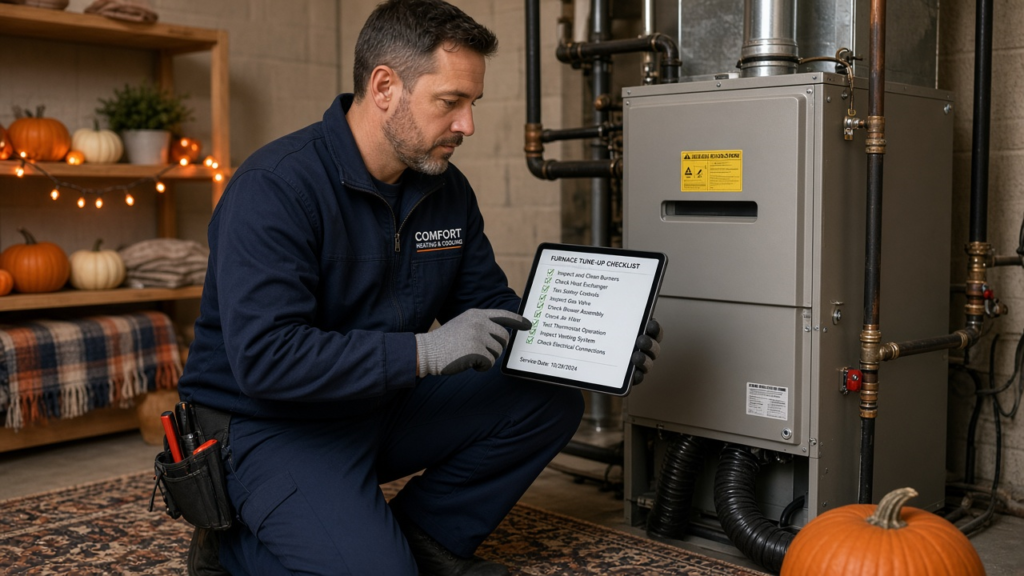
A fall tune-up done with time to spare means if a technician finds a worn igniter, a failing inducer motor, or a cracked heat exchanger, there’s time to order the part, schedule the repair, and get it resolved before you’re actually counting on the furnace to keep your house warm overnight. Compare that to finding the same issue during an emergency no-heat call in January, where you might be without heat for a day or two while parts are sourced — a much bigger problem when it’s actually cold.

Specialty parts can take longer to source in winter. Less common furnace models or older systems sometimes require ordering a specific part, which can take a few days. In fall, that’s a minor scheduling inconvenience. In the middle of a cold snap with no heat, it’s a real hardship — especially for households with young children, elderly family members, or pets.

Does Timing Actually Affect Pricing?

Standard maintenance pricing (the tune-up itself) generally doesn’t change based on season — a tune-up costs what it costs regardless of when you book it. Where timing does affect your wallet is in two indirect ways: first, catching a developing problem in fall is almost always cheaper to fix than letting it fail completely and become an emergency repair (which may also carry after-hours or weekend emergency rates if it fails at an inconvenient time). Second, avoiding an emergency no-heat situation means avoiding the cost of space heaters, potential pipe-freeze risk if heat is out for an extended period, and the simple cost of discomfort and disruption.

What Gets Missed When You Wait Until Winter

Technicians performing an emergency no-heat repair in the middle of winter are, understandably, focused on getting the specific failure resolved and your heat back on — not necessarily doing the full proactive inspection that a scheduled fall tune-up includes. That means slow-developing issues (a slightly degraded heat exchanger, a flame sensor getting close to failure, a blower motor bearing starting to wear) are more likely to be caught during an unhurried fall visit than during a stressed, time-pressured emergency call where the goal is simply restoring heat as fast as possible.


The bottom line: Fall maintenance isn’t about squeezing more revenue out of homeowners — it’s genuinely the best-positioned time of year to catch problems while they’re cheap to fix and while you have the scheduling flexibility to deal with them calmly.

Ready to Fix Your HVAC Issue?

Call Blue Collar Heating & Air for expert service in the Denver Metro area. Same-day appointments available.

✓ Licensed & Insured ✓ 20+ Years Experience ✓ Transparent Pricing

Frequently Asked Questions

Is fall HVAC maintenance actually necessary, or is it just upselling?

It’s genuinely useful. Fall maintenance is less about generating service revenue and more about scheduling flexibility and catching issues early, before winter demand makes repairs slower and more stressful to deal with.

How much longer do I have to wait for an appointment in winter vs. fall?

During a cold snap, non-emergency tune-up appointments can be delayed 1-2 weeks as companies prioritize no-heat emergency calls. In fall, same-week scheduling with your choice of time window is typically available.

Does scheduling maintenance in fall save me money?

Indirectly, yes. Catching a developing issue in fall is typically cheaper than letting it progress to a full failure, which may require emergency service rates and comes with the added cost/disruption of being without heat.

What’s the latest I should book fall maintenance before it’s “too late”?

Early-to-mid September is ideal. By early October, scheduling starts tightening up, and by November you’re often competing with emergency no-heat calls for appointment slots.

Does an emergency winter repair get the same thorough inspection as a fall tune-up?

Not usually. Emergency calls are typically focused on resolving the specific failure and restoring heat as quickly as possible, rather than the comprehensive, unhurried inspection included in a scheduled fall tune-up.


Free estimates • Licensed & Insured • ICC Certified

Table of Contents

Family-Owned, Community-Trusted

Verified On

Not ready to call? We'll reach out to you.

Fill out the form and we'll get back to you as soon as possible during business hours. Free quote, no obligation.

Family Owned Licensed & Insured Same-Day Service

    Call Now Schedule