In This Article
“How long should my furnace last?” is one of the questions we get most often, especially from homeowners who just moved to Denver and are used to different climate assumptions from wherever they lived before. The national average answer and the honest Denver-specific answer aren’t quite the same.
⚡ Quick Answer: Furnace Lifespan in Denver
National Average vs. Denver Reality
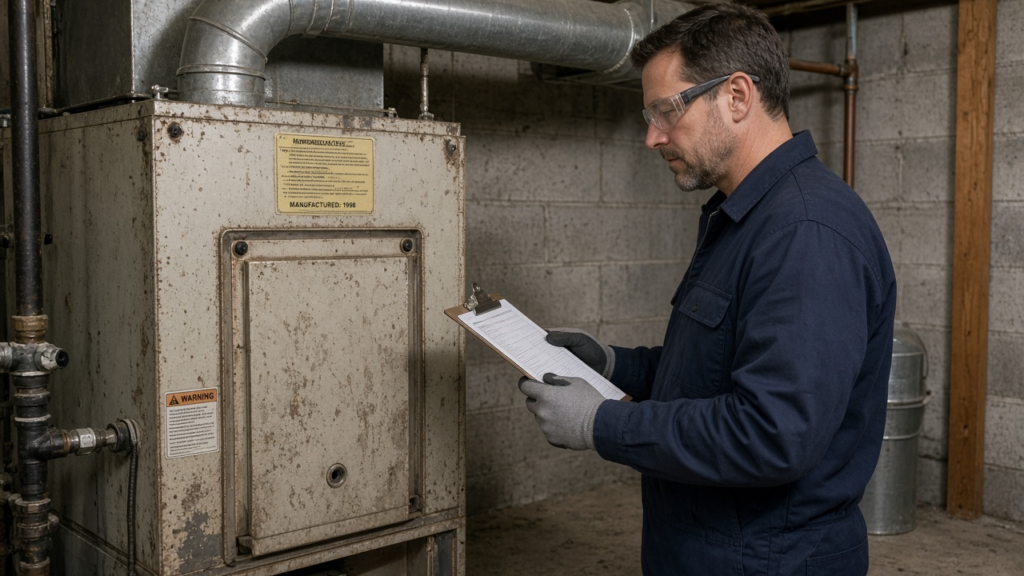
The widely-cited national average for a gas furnace is 15-20 years with proper maintenance. Denver furnaces generally fall within that same range — but with notably more variance, and a real split between well-maintained systems and neglected ones. We regularly see furnaces still running reliably at 22-25 years with consistent annual maintenance, and we regularly see furnaces failing in the 10-12 year range when maintenance was skipped entirely.
The reason the spread is wider in Denver comes down to altitude. At 5,280 feet, furnaces run with roughly 17% less oxygen-dense air than at sea level. Most modern furnaces compensate for this through altitude-adjusted gas orifices and pressure settings set during installation, but it means the ignition system, gas valve, and heat exchanger are operating closer to their design tolerances here than they would at sea level — which makes proper, specifically-altitude-calibrated installation and consistent maintenance more important than in lower-elevation markets.
What Shortens Furnace Lifespan at Altitude
Improper Altitude Calibration at Installation
A furnace installed without properly adjusting gas pressure and orifice sizing for Denver’s elevation will run inefficiently and put more strain on components from day one — even if it seems to work fine initially. This is one of the most overlooked factors in premature furnace failure here, and it’s entirely dependent on installer quality rather than the furnace brand or model itself.
Skipped Annual Maintenance
Dust and debris accumulation on the heat exchanger, a dirty flame sensor, worn igniters, and gradual gas pressure drift all compound over years without inspection. A furnace running inefficiently for years works harder than it should to reach the same temperature, accelerating wear across the board.
Oversized or Undersized Original Installation
A furnace sized incorrectly for the home it’s heating — too large and it short-cycles constantly, too small and it runs nonstop trying to keep up — experiences more wear than a correctly-sized system running normal duty cycles.
Dirty Filters Over Time
Chronically neglected filters restrict airflow, forcing the blower motor and heat exchanger to work harder and run hotter than designed, which accelerates component fatigue over years of cumulative strain.
How to Extend Your Furnace’s Life
Repair vs. Replace: The Decision Framework
We use a straightforward framework with homeowners facing a repair decision on an aging furnace, sometimes called the “50% rule”: if the repair cost exceeds 50% of the cost of a new furnace, and the existing unit is more than 10-12 years old, replacement usually makes more financial sense than repair. Below that threshold, repair is usually the better value, especially for furnaces under 10 years old.
Beyond pure repair economics, also factor in efficiency gains — a furnace from 15-20 years ago is typically 78-80% AFUE efficient, while modern furnaces commonly reach 95-98% AFUE. For an older furnace needing a significant repair, that efficiency jump alone can offset a meaningful chunk of replacement cost over time through lower gas bills.