In This Article
Short cycling is one of those problems that’s easy to dismiss at first — the furnace is technically working, it’s just turning on and off a lot more than it used to. But short cycling accelerates wear on nearly every component in the system and usually points to an underlying issue worth catching early.
⚡ Quick Answer: Furnace Short Cycling
What Short Cycling Actually Looks Like
A healthy furnace typically runs a heating cycle of 10-15+ minutes before satisfying the thermostat and shutting off, then stays off for a reasonable stretch before the next cycle. Short cycling means the furnace turns on, runs for just a few minutes (sometimes under 5), shuts off, and then fires back up again shortly after — repeating this pattern far more frequently than it should.
Common Causes of Short Cycling
1. Dirty Air Filter
A restricted filter reduces airflow across the heat exchanger, causing it to overheat faster than normal and trip the high-limit safety switch prematurely — shutting the burner off well before a full, efficient cycle completes. This is the single most common cause we find, and the easiest to rule out.
2. Oversized Furnace
A furnace that’s too large for the home it’s heating reaches the thermostat’s setpoint very quickly, shuts off, and then the house cools back down and triggers another cycle sooner than it should. Unlike a dirty filter, this isn’t something that can be “fixed” without addressing the underlying sizing — it’s a design/installation issue rather than a maintenance issue.
3. Thermostat Location Problems
A thermostat located near a supply vent, in direct sunlight, or near a drafty window can read temperature inaccurately, causing it to think the setpoint has been reached (or that the room is cold) faster than reality, triggering premature on/off cycling.
4. Flame Sensor Issues
As covered in our flame sensor guide, a dirty or failing flame sensor can cause the furnace to ignite, briefly run, then shut off because the sensor loses contact with (or fails to properly detect) the flame — a specific type of short cycling tied to ignition rather than airflow or thermostat issues.
5. Blocked or Closed Vents
Too many closed or blocked supply vents throughout the house restricts overall airflow similarly to a dirty filter, triggering the same high-limit protective shutoff.
6. Failing Control Board or Sensors
Less commonly, a failing control board or a faulty limit switch itself (rather than a genuine overheating condition) can cause the system to cycle improperly even when airflow and sizing are fine.
Why Short Cycling Matters Beyond Annoyance
Every furnace start-up puts more mechanical and electrical stress on components than steady-state operation — the igniter, blower motor, and gas valve all experience their highest wear during startup and shutdown, not during the middle of a normal run cycle. A furnace short cycling dozens of extra times per day accumulates wear far faster than one running normal, longer cycles, which can meaningfully shorten the system’s overall lifespan beyond the immediate comfort and efficiency downsides.
Short cycling is also inefficient — furnaces reach their best efficiency once they’ve been running steadily for several minutes, so frequent short bursts waste more energy per unit of heat delivered than longer, complete cycles.
How Short Cycling Gets Fixed
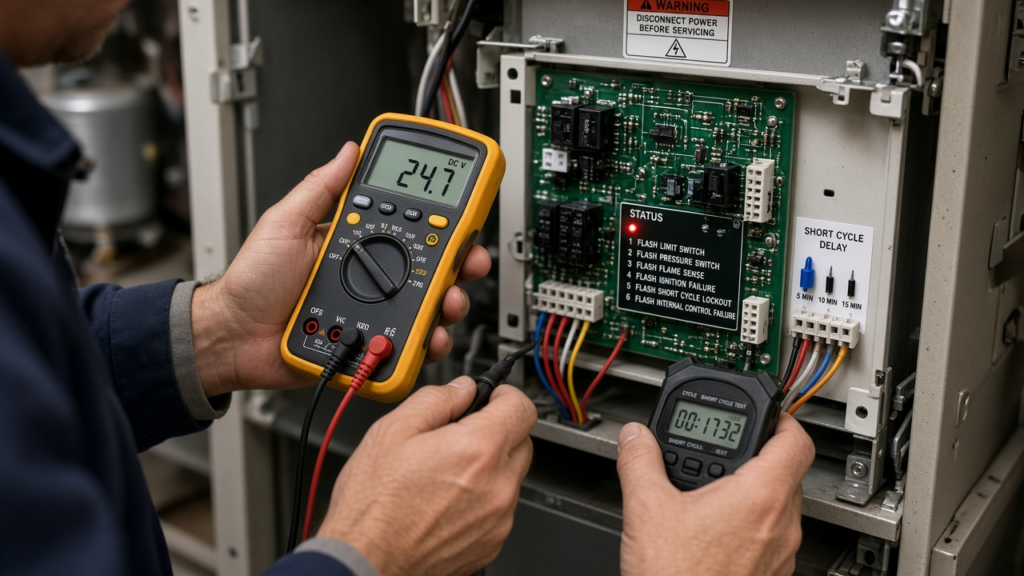
The fix depends entirely on the cause, which is why a proper diagnostic visit matters more than guessing. A technician will typically check filter condition and airflow first (easiest and most common cause), then move to thermostat calibration and placement, then flame sensor and ignition system performance, and finally — if everything else checks out — evaluate whether the furnace itself may be oversized for the home, which would have been determined at installation rather than something that developed over time.