
In This Article
“Just match what’s already there” is the single most common (and most flawed) approach to furnace replacement sizing. A lot of furnaces were oversized to begin with, and simply duplicating that mistake on a replacement locks in the same short cycling, uneven heat, and efficiency problems for another 15-20 years. Here’s how sizing actually should work.
⚡ Quick Answer: Furnace Sizing
Why Sizing Matters So Much
An oversized furnace heats your home quickly, then shuts off, then the house cools and it fires back up again shortly after — the short cycling we cover in detail in a separate article. This isn’t just an efficiency problem; constant starting and stopping wears out igniters, blower motors, and gas valves faster, and the rapid cycles never give the system time to properly dehumidify or evenly distribute heat before shutting off.
An undersized furnace faces the opposite problem: it runs nearly constantly during cold weather, struggling to reach the thermostat’s setpoint, which means higher gas bills and a home that never quite feels warm enough on the coldest days.
How Proper Sizing Actually Works
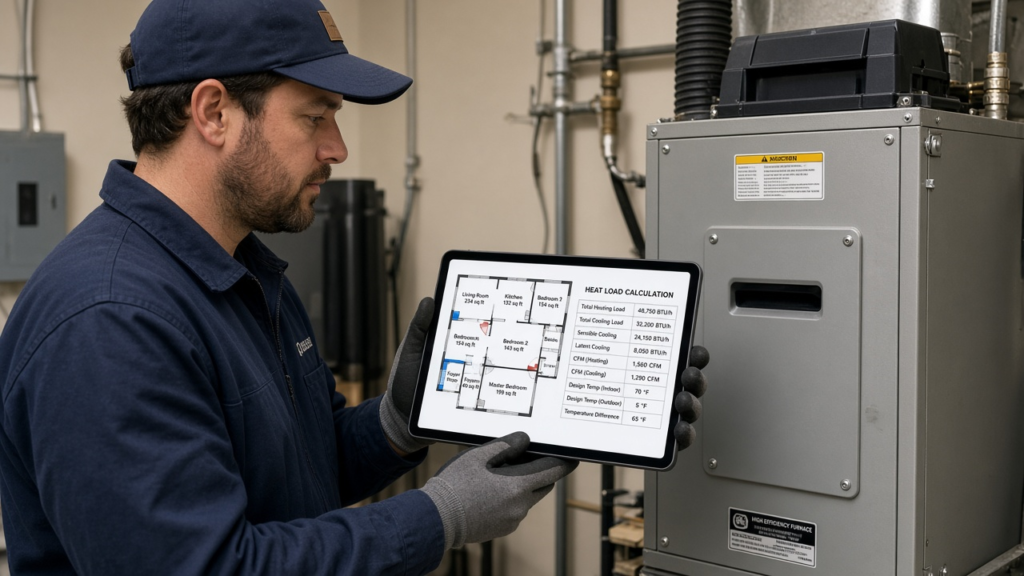
The industry-standard method is a Manual J load calculation, a detailed assessment that accounts for your home’s square footage, insulation levels, window type and area, ceiling height, air leakage, local climate design temperatures, and even which direction the home faces. This produces a specific BTU heating load requirement unique to your home — not a generic “1,500 sq ft = X BTU” rule of thumb, which ignores huge variables like insulation quality and window performance.
Two identical 2,000 sq ft homes can have genuinely different heating loads if one has older single-pane windows and minimal attic insulation while the other has been upgraded with modern windows and R-49 attic insulation. A proper load calculation captures that difference; a square-footage rule of thumb doesn’t.
Denver’s Altitude Derating Factor
Here’s a genuinely Denver-specific wrinkle: furnace BTU output ratings are based on sea-level combustion. At altitude, with less oxygen-dense air, a furnace’s actual heat output derates — roughly 4% per 1,000 feet of elevation above sea level, which works out to approximately a 20% reduction at Denver’s 5,280 feet compared to its rated sea-level output.
A properly done Denver installation accounts for this derating in the sizing calculation and/or through appropriate gas orifice and manifold pressure adjustments made during installation (the same altitude calibration we cover in our furnace lifespan article). This is a technical detail that’s easy for an inexperienced installer to overlook, and it’s worth specifically asking about if you’re getting quotes for a new furnace.
Signs Your Current Furnace Is the Wrong Size
If you’re noticing several of these and your furnace is approaching replacement age anyway, it’s worth specifically requesting a load calculation as part of your replacement quote rather than assuming the next furnace should simply match the old one’s capacity.