
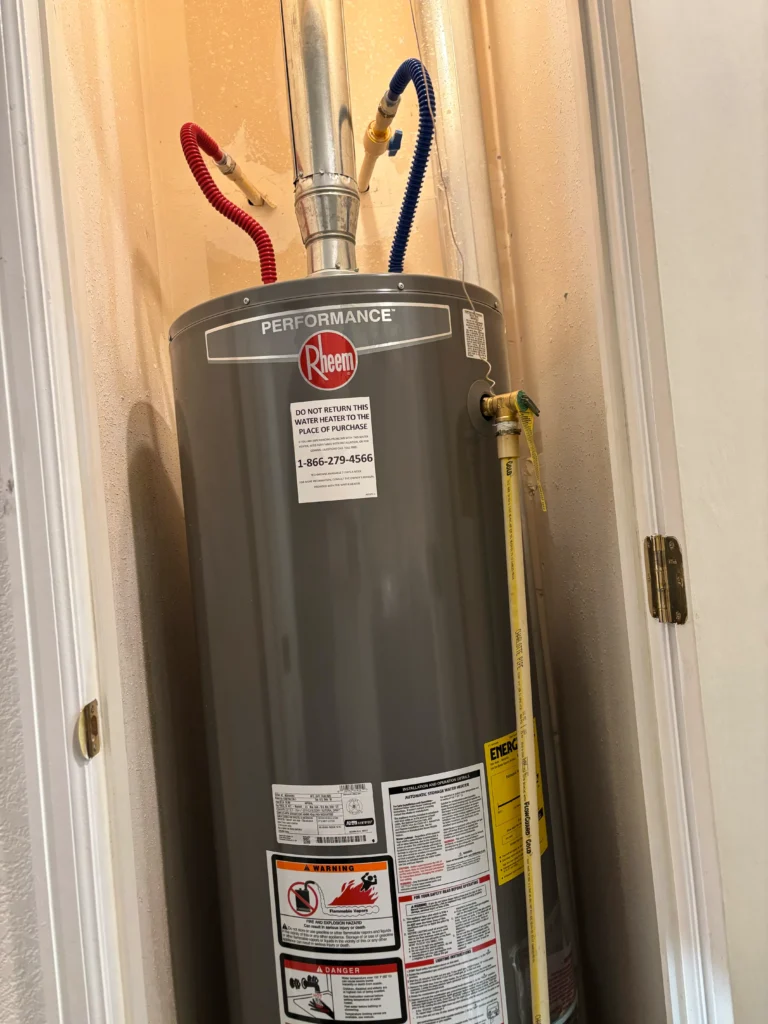
Quick answer: In the Denver metro, replacing a standard residential tank water heater commonly falls in a rough range of roughly $1,800–$3,800 installed for common 40–50 gallon gas or electric units, depending on tank size, fuel type, venting, code upgrades, and access. Tankless conversions often run higher upfront because of gas line, venting, and labor complexity. The only accurate number is a written quote after we see your existing installation and local code requirements.
What drives the price
Equipment
- Tank size (40 vs 50 vs 75 gallon)
- Efficiency tier and brand
- Electric vs gas — Electric tanks cost less for the appliance but may need panel/wiring work; gas needs combustion safety and venting right.
Installation labor
- Like-for-like swap in an open basement is faster than a tight closet, attic, or crawl replacement.
- Code updates — Expansion tanks, gas shutoffs, venting, seismic strapping, drain pan requirements—jurisdictions and inspectors vary.
Hidden gotchas (common in older Colorado homes)
- Corroded dielectric unions and stuck connections
- Non-compliant vent or undersized gas line discovered at changeout
- Hard water scale that masked a slow leak until removal
Tank vs tankless (cost snapshot)
Tank: Lower installed cost for most straight swaps; predictable hot water; standby loss.
Tankless: Higher equipment + labor; excels for space savings and long-run hot water when sized correctly; gas upgrades and flush maintenance matter.
We size tankless by peak flow (fixtures that can run at once), groundwater temperature, and gas availability—not by square footage alone.
Permits and safety
Many replacements require a permit and inspection. We handle code-compliant installs—not shortcuts that risk CO with gas appliances or scalding with improper mixing valves.
Is repair ever better than replace?
If the tank is young, the issue is a replaceable component (element, thermostat, gas valve, anode strategy), repair can win. If the tank is past typical life, leaking from the shell, or inefficient and undersized for your family, replacement is usually smarter.
Ready to Fix Your HVAC Issue?
Call Blue Collar Heating & Air for expert service in the Denver Metro area. Same-day appointments available.
FAQ
How long does replacement take?
Many swaps are same day; complex vent or gas work can extend.
Do you haul away the old tank?
Yes—that is standard in our quotes.
Will a bigger tank fix running out of hot water?
Sometimes; other times the fix is recovery (burner/electrical), mixing valve, or usage pattern—see our related article.
Do you offer financing?
Ask when you call—we can review current options.
Why do quotes vary so much?
Different code interpretations, warranty length, component quality (valves, pans), and ducting of combustion air all move price.
Contact Blue Collar Heating & Air at (303) 351-1667 for an on-site water heater assessment and firm pricing.