
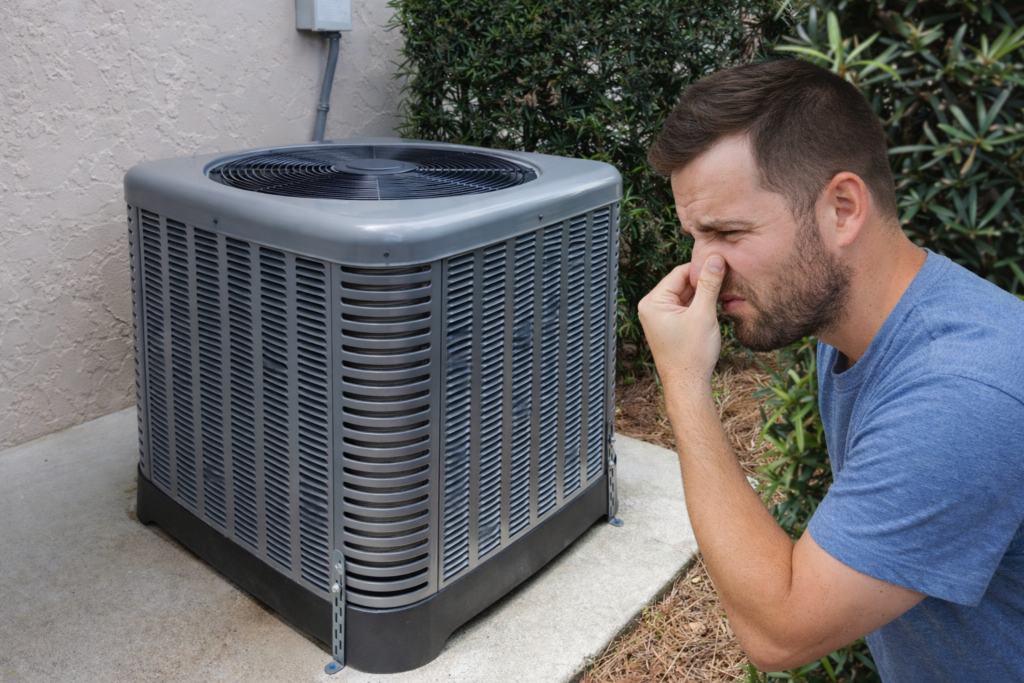
Quick answer: A brief musty or “dirty sock” odor when cooling first starts usually comes from organic growth and biofilm on the wet evaporator coil, stagnant water in the drain pan, or moisture left on the coil after the last cycle. It often fades after a few minutes. If the smell is constant, sewer-like, burning, or gas-like, treat those as different problems and call a professional.
What is actually smelling?
Your evaporator coil is cold and wet in cooling mode—ideal conditions for microbial odor if dust and organics accumulate on the coil or in the pan. When cooling kicks on, airflow pushes that smell through the ducts first, then often dilutes as the coil stabilizes.
Homeowners also report musty starts when:
- The filter is dirty or bypassing dust onto the coil.
- Condensate drainage is slow or partially blocked—water sits in the pan longer.
- Seasonal changeover in spring/fall alternates heating and cooling; moisture lingers on internal surfaces.
What usually helps (practical steps)
1. Replace a high-quality media filter on schedule and make sure it fits the rack without gaps that bypass air.
2. After a cooling cycle on a humid day (or during shoulder season), run the fan for several minutes on its own to help dry the coil—many odor complaints improve when the coil is not sitting wet in a warm cabinet.
3. Confirm the condensate drain exits where you expect; a trap dry-out or drain tied incorrectly can pull odors (that is different from “coil smell” but feels similar at the registers).
Professional cleaning and maintenance
If the odor is strong or persistent, coil and pan cleaning during a tune-up or dedicated service is the fix that addresses the source. We evaluate whether the coil is fouled, whether the drain is flowing, and whether insulation or other materials in the cabinet are contributing.
We are honest about upsells: a whole-home air cleaner can improve particles in the airstream, but it does not replace cleaning a contaminated coil or fixing drainage. We recommend what matches the actual problem.
When to worry about something else
- Rotten egg / sewer gas — Possible dry trap or drain connection issue; also rule out unrelated plumbing.
- Electrical burning — Shut the system off and call for service.
- Natural gas — Leave the home and call your gas provider from outside; not an “AC smell” fix.
Denver climate angle
Colorado’s dry climate does not eliminate coil wetness during cooling; it changes how fast things dry between cycles. Shoulder seasons—when you toggle heat and cool—are when we hear “first five minutes smell” most often.
Ready to Fix Your HVAC Issue?
Call Blue Collar Heating & Air for expert service in the Denver Metro area. Same-day appointments available.
FAQ
Is musty AC smell dangerous?
Typical short-lived coil odors are unpleasant, not usually an emergency. Persistent odors or any burning/gas smell needs a different response.
Will UV lights fix it?
They may reduce biological growth if sized and maintained correctly; they are not a substitute for a dirty coil or bad drainage.
Can I spray cleaner on the coil myself?
Risky without training—wrong chemicals corrode metals, damage fins, or void warranty. Professional cleaning is safer.
Does a new filter always fix it?
It helps when dust load was the driver; deep coil fouling still needs mechanical/chemical cleaning by a pro.
General information only. Blue Collar Heating & Air provides inspections and cleaning for homeowners across the Denver metro.