How Much Does Furnace Replacement Cost? (Denver HVAC Expert Explains)
Quick Answer: Furnace replacement in Denver costs $3,500-$7,500 installed, depending on size, efficiency, and features. Entry-level 80% AFUE furnaces run $3,500-$5,000 for a 60,000-80,000 BTU unit. Mid-range 92-95% AFUE (high-efficiency) costs $4,500-$6,000. Premium 96-98% AFUE variable-speed systems reach $6,000-$7,500. At Denver’s 5,280-foot altitude, furnace sizing is critical – oversized units waste energy and short-cycle; undersized units run constantly during single-digit nights. Blue Collar Heating & Air has replaced hundreds of furnaces across Northglenn, Thornton, and Westminster – here’s exactly what you’ll pay and why.
What Determines Furnace Replacement Cost?
Furnace replacement cost breaks down into several factors:
Equipment Cost (55-65% of total)
- 80% AFUE: $1,800-$3,000 equipment only. Single-stage, basic warranty.
- 92-95% AFUE: $2,500-$4,000 equipment. Two-stage, variable-speed blower, 10-year warranty.
- 96-98% AFUE: $3,500-$5,000 equipment. Modulating gas valve, ultra-quiet, advanced diagnostics.
Labor & Installation (25-35% of total)
Professional installation runs $1,500-$2,500 and includes removal, mounting, gas/electrical connections, venting, testing, altitude adjustment, and permits.
Additional Costs
- Ductwork modifications: $500-$2,000
- Thermostat upgrade: $150-$400
- Gas line upgrades: $400-$1,200
- Humidifier: $400-$700
- Air purifier: $600-$1,500
Furnace Sizing for Denver Homes
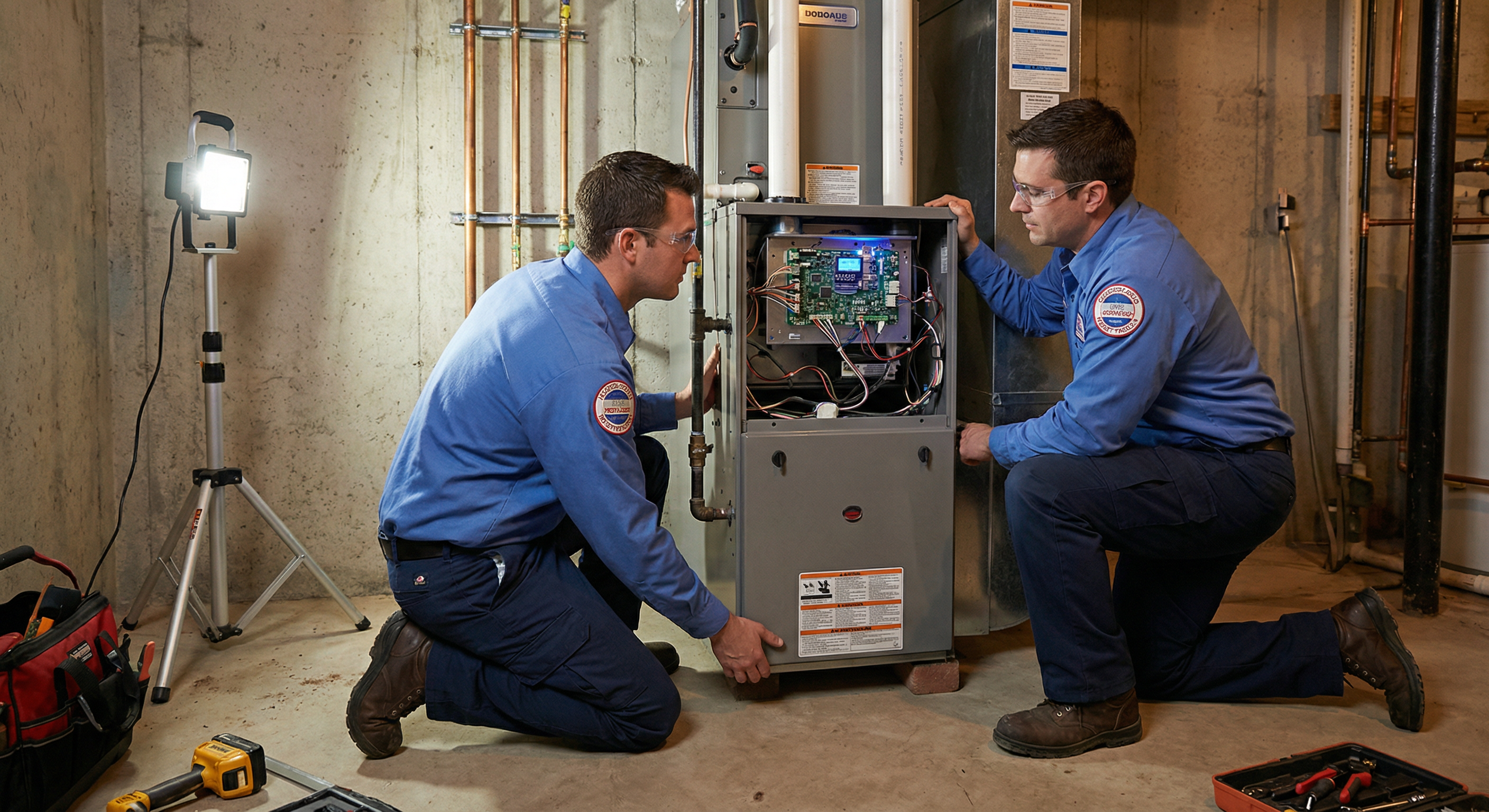
Furnace installation: $3,500-$7,000 in Denver
Rule of thumb doesn’t work at altitude.
Sea-level: 40-45 BTU per sq ft
Denver: 35-40 BTU per sq ft (thinner air requires different calculation)
Common Denver furnace sizes:
- 1,000-1,400 sq ft: 40,000-60,000 BTU
- 1,400-1,800 sq ft: 60,000-80,000 BTU
- 1,800-2,400 sq ft: 80,000-100,000 BTU
- 2,400-3,000 sq ft: 100,000-120,000 BTU
80% vs. 95% Efficiency: Is It Worth It?
Short answer: Yes, if you’re staying 7+ years.
80% AFUE: $80 heats your home, $20 wasted. Denver winter bill: $180-$250/month. Vents through chimney. Lifespan: 15-18 years.
95% AFUE: $95 heats your home, $5 wasted. Denver winter bill: $140-$190/month. Requires PVC venting. Lifespan: 18-22 years.
Real savings: $40-$80/month × 4-5 months = $200-$400/year. Premium cost: $1,000-$1,500. Breakeven: 3-5 years.
Best Furnace Brands for Denver
Top tier:
- Carrier/Bryant: 92-98% AFUE, excellent parts availability
- Trane/American Standard: Durability, strong dealer network
- Lennox: Highest efficiency (98% AFUE), SunSource solar-ready
Mid-tier:
- Rheem/Ruud: Solid reliability, 10-year warranty
- York: Affordable, decent performance
Budget:
- Goodman/Amana: Entry pricing, improved quality
When to Replace vs. Repair
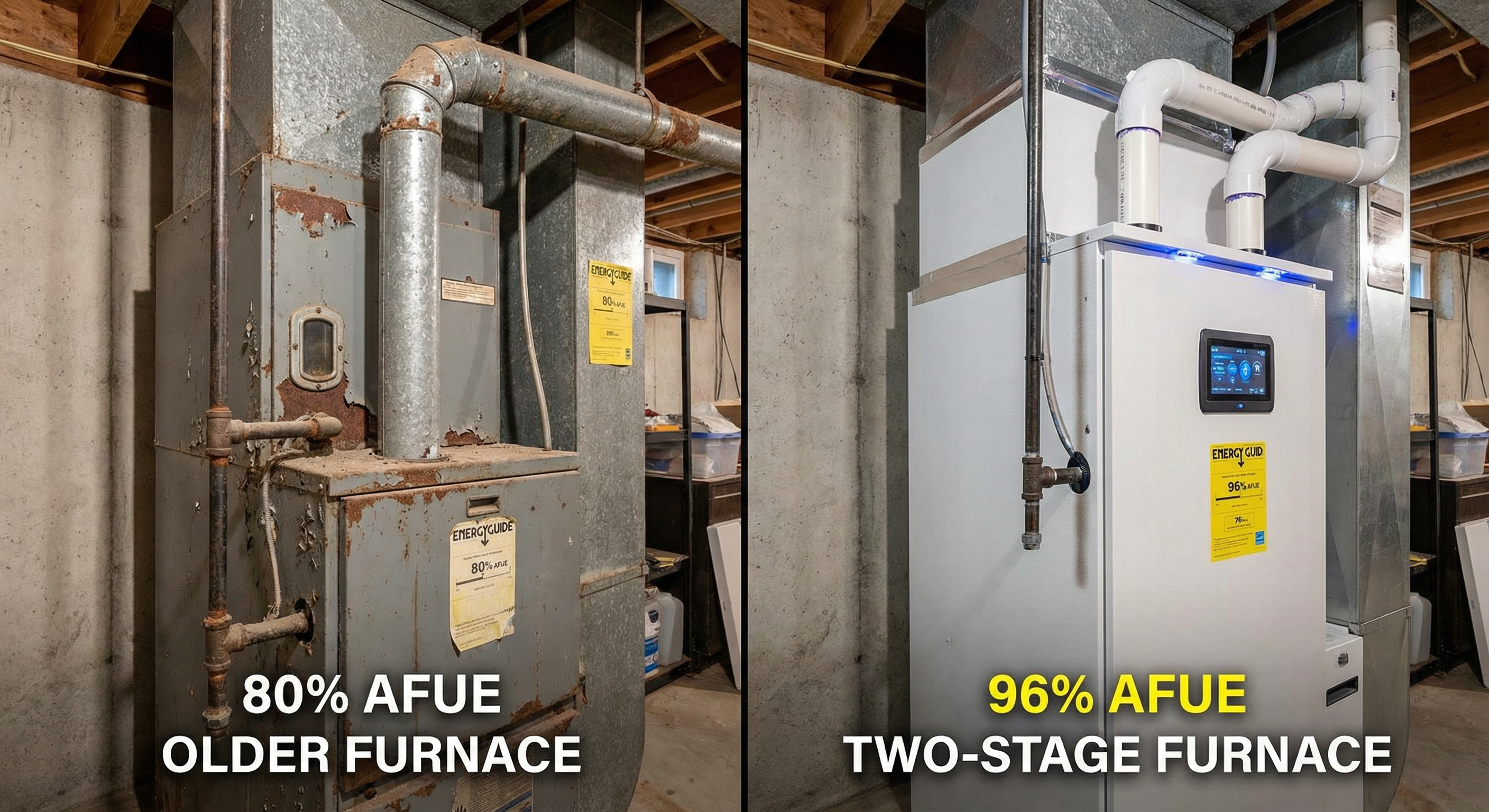
80% AFUE vs 96% AFUE – $300-500/year savings
$5,000 Rule: Age × Repair Cost
- 15 years old, $500 repair: 15 × $500 = $7,500 → Replace
- 8 years old, $400 repair: 8 × $400 = $3,200 → Repair
Other replacement triggers:
- Furnace 18+ years old
- Cracked heat exchanger (carbon monoxide risk)
- Frequent breakdowns (3+ repairs in 2 years)
- Efficiency under 80%
What Our Customers Say
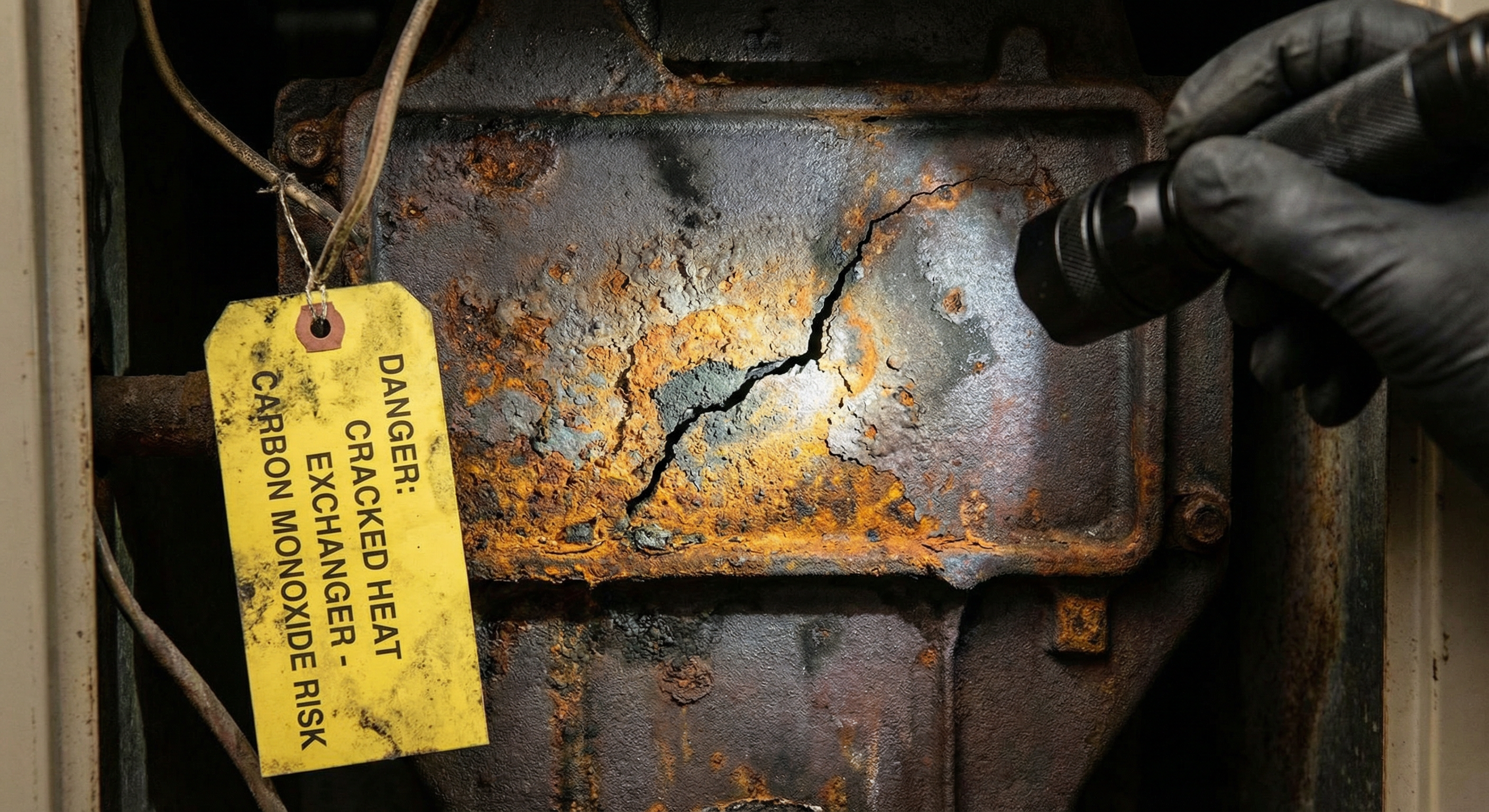
Cracked heat exchanger – immediate replacement required
“My furnace stopped working for a few days. Lance and Keith came the day after I called, explained why the old furnace (35 years) needed to be replaced, and the next day they came and did a remove/replace in about 3 hours. Worked perfectly.”
— Paul, Denver Metro
Google Review | 2024 | Click to see all 67 reviews
FAQ: Furnace Replacement Questions
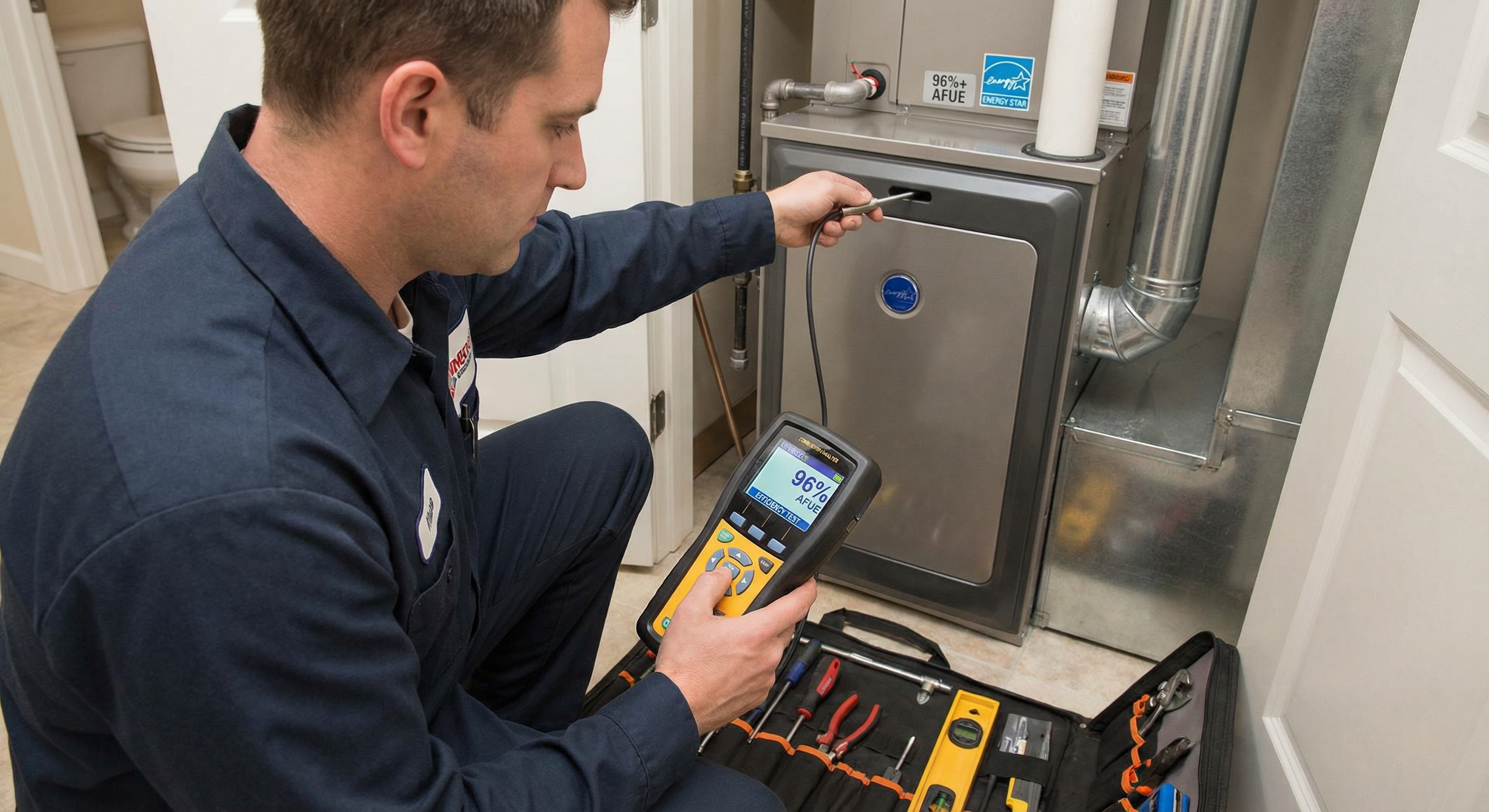
Testing 96% AFUE rating on new high-efficiency furnace
How long does furnace installation take?
Most standard replacements take 6-8 hours (one day). Complex jobs with gas line upgrades or electrical work can take 1.5-2 days.
Should I replace my AC at the same time?
If your AC is 10+ years old, yes. You’ll save $800-$1,200 on labor by doing both at once, plus get matched systems with full warranty.
What’s the best time to replace?
September-October (after cooling, before heating) or April-May. Avoid peak winter when prices are higher and wait times longer.
How long do furnaces last in Denver?
80% AFUE: 15-18 years. 95%+ AFUE: 18-22 years. Denver’s altitude and cold stress furnaces more than mild climates. Annual maintenance adds 3-5 years.
Conclusion
Furnace replacement in Denver costs $3,500-$7,500 installed. Entry-level 80% AFUE systems run $3,500-$5,000. High-efficiency 95% AFUE furnaces cost $4,500-$6,000 and pay for themselves in 3-5 years through energy savings.
At Blue Collar Heating & Air, we provide transparent pricing, altitude-optimized installation, and help you navigate rebates and financing.
Need a furnace replaced? Call (303) 351-1667 for a free estimate. We’ll assess your home, explain your options, and provide exact pricing – same day or next day service available.
Why Is My Heater Not Working? (Denver HVAC Expert Explains)
Quick Answer: If your heater isn’t working, check these first: thermostat settings (make sure it’s set to HEAT), circuit breakers, furnace door switch, air filter, and gas valve (should be parallel to the pipe). In Denver, the #1 cause of furnace failure is a dirty or clogged flame sensor ($200-$300 cleaning/replacement, 1 hour repair). Other common issues include pilot light problems, thermocouple failures, or limit switch trips. Blue Collar Heating & Air has diagnosed hundreds of “no-heat” calls across Northglenn, Thornton, and Westminster – most are fixable same-day without full replacement.
The “Complete Silence” Problem
You wake up to a freezing house. You check the thermostat – it says 58°F when it should be 70°F. You walk to the furnace and… nothing. Complete silence. No click, no hum, no warm air.
This is the call I get 5-10 times every winter in Denver. And here’s what I’ve learned after 20+ years: 80% of “dead” furnaces aren’t actually dead. They’re usually tripped by a safety mechanism or have a simple fix that doesn’t require replacement.
8 Common Reasons Your Heater Won’t Work
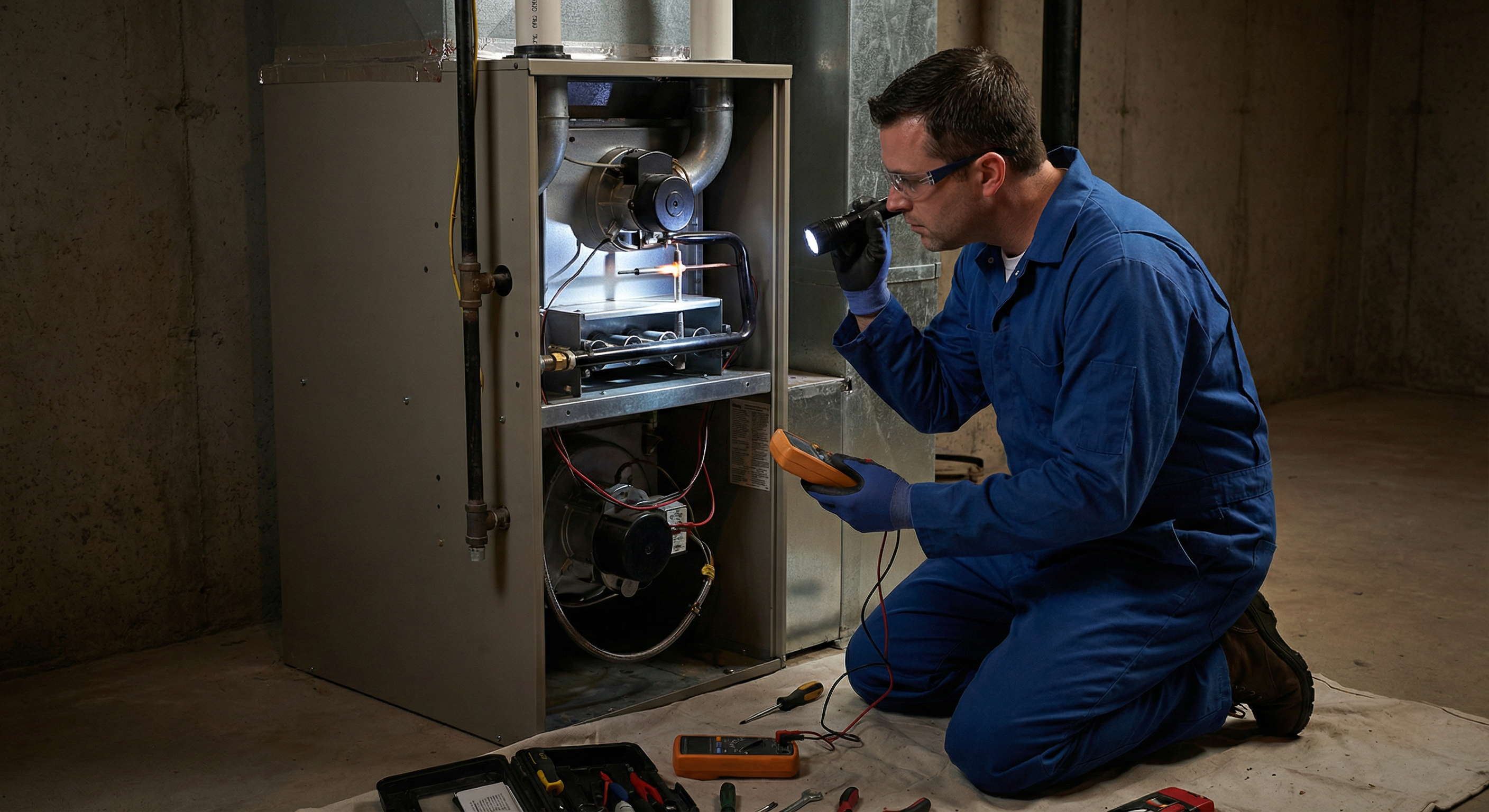
Dirty flame sensor – #1 cause of furnace lockouts
1. Thermostat Issues (30% of calls)
Symptoms: Furnace completely silent, no clicking, no fan.
Check these first:
- Batteries: If you have a battery-powered thermostat, replace batteries first
- Settings: Verify it’s set to HEAT (not AC or OFF)
- Display: If screen is blank, check furnace breaker
DIY Fix: Replace batteries, verify settings.
Cost if you need a pro: $150-$300 thermostat replacement
2. Tripped Circuit Breaker (20% of calls)
What to check: Open electrical panel, look for “Furnace” breaker. If tripped (middle position), flip fully OFF then back ON.
Denver-specific: Single-digit nights cause furnaces to work harder, potentially tripping weak or old breakers.
Cost: Breaker replacement $150-$300. Component causing trip: $300-$800
3. Dirty or Failed Flame Sensor ($200-$300)
Symptoms: Furnace starts, igniter clicks, burners light for 3-5 seconds, then shut off. Cycle repeats.
Why common in Denver: High altitude = less oxygen. Furnaces run richer fuel mixture, producing more soot on flame sensors.
Cost: $200-$300 for cleaning/replacement (30-60 min job)
4. Clogged Air Filter (25% of calls)
Symptoms: Furnace starts, runs briefly, shuts off. Weak airflow. May restart after 15-30 minutes.
Denver’s dirty secret: Our dry, dusty air clogs filters FAST. Change every 30-60 days during heating season, not the manufacturer’s “90 days.”
Cost: Filters $15-$30. Damaged limit switch from overheating: $150-$300
5. Pilot Light or Igniter Problems ($200-$400)
Older furnaces: Check if pilot light is lit. Won’t stay lit = failing thermocouple.
Newer furnaces: Electronic igniter glows orange but burners don’t light = cracked igniter.
Cost: Thermocouple $150-$250. Hot surface igniter $200-$400
6. Condensate Drain Clog (High-Efficiency Furnaces)
Symptoms: Furnace won’t start, or starts then shuts down. Water pooling near furnace.
What’s happening: High-efficiency furnaces produce condensation. Clogged drain = safety switch trips.
DIY Fix: Clear drain line, pour cup of vinegar monthly.
Cost for pro: $150-$250 line cleaning. Pump replacement $300-$500
7. Gas Valve Issues or Gas Supply
Check: Gas shutoff valve should be parallel to pipe (OPEN). If perpendicular, it’s closed.
Emergency: If you smell rotten eggs/sulfur (gas leak), GET OUT and call Xcel Energy 1-800-895-2999
Cost: Gas valve replacement $300-$600
8. Limit Switch or Pressure Switch Failure ($200-$400)
Symptoms: Furnace doesn’t start at all, or starts then immediately shuts down.
Denver altitude factor: Pressure switches must be altitude-calibrated. Out-of-state installers sometimes use sea-level parts.
Cost: Limit switch $200-$300. Pressure switch $200-$400
Emergency Heating Safety: What You Should NEVER Do
DON’T:
- Use oven or stove for heat (carbon monoxide risk)
- Leave space heaters unattended
- Bypass safety switches
- Run furnace that smells like gas
DO:
- Call emergency service if you smell gas
- Use space heaters with tip-over protection
- Keep one room warm while waiting for repair
What Our Customers Say
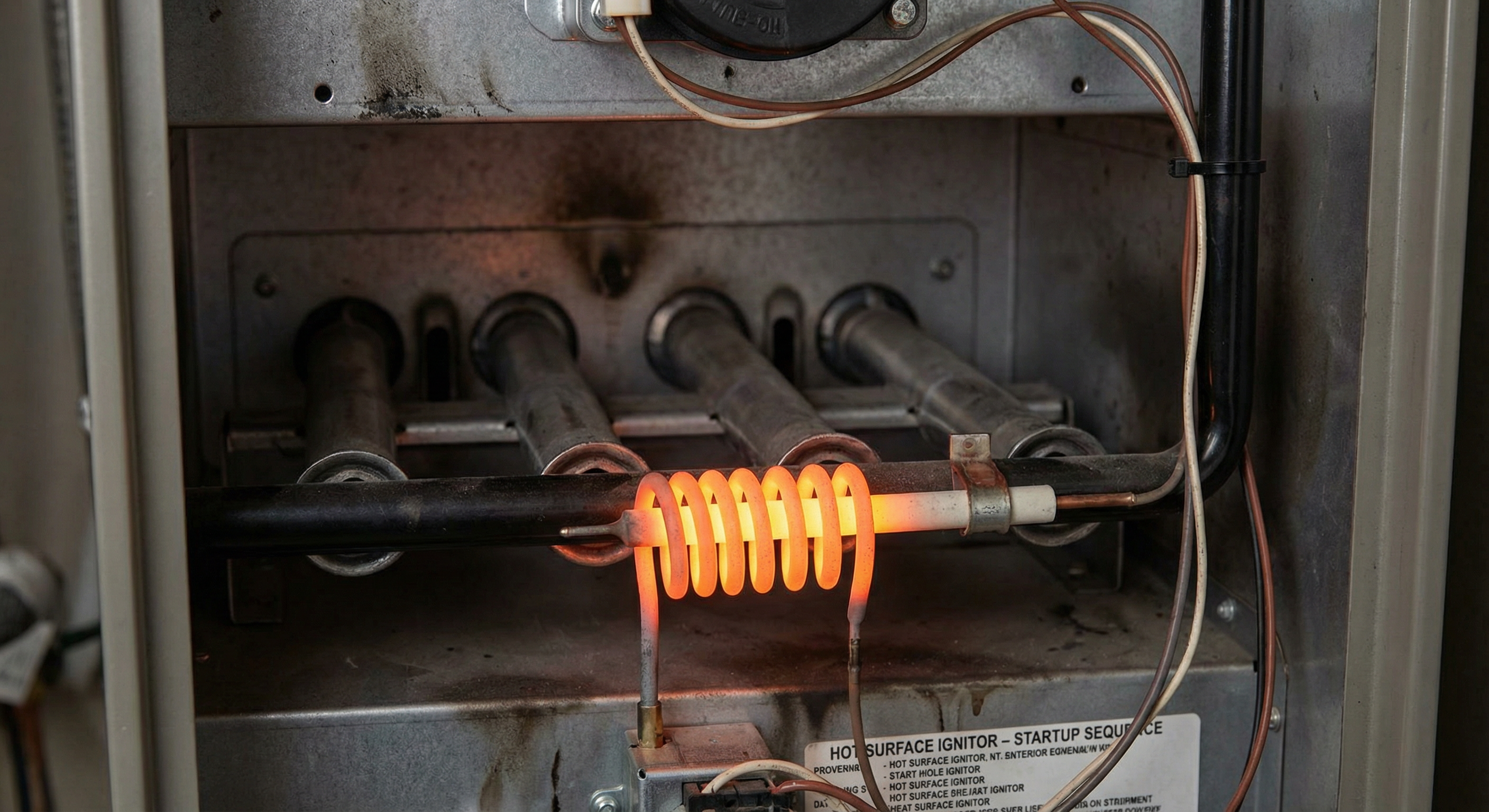
Ignitor glowing but burners not lighting? Gas valve issue
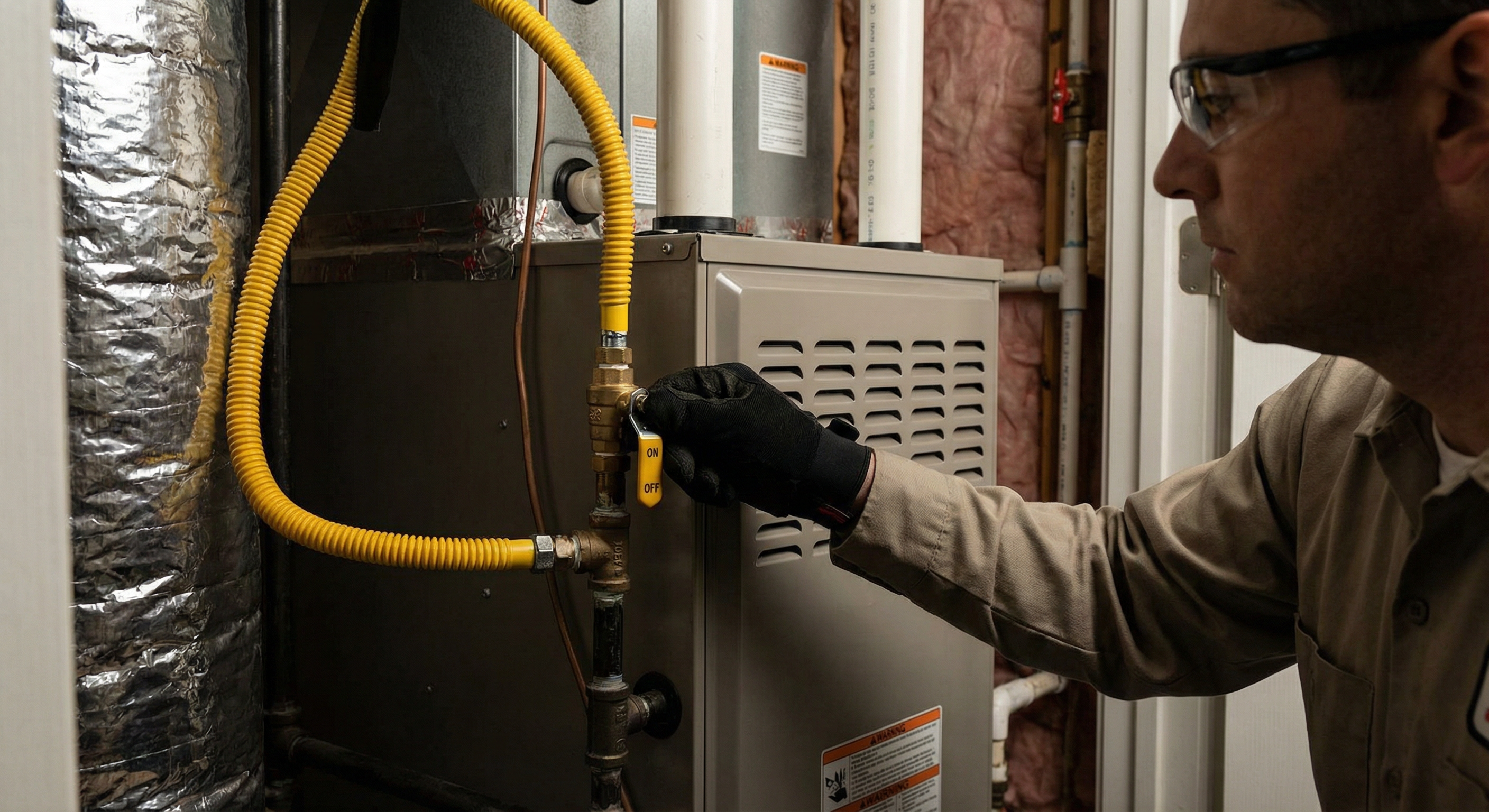
Gas valve troubleshooting – check ON/OFF position first
“Incredibly responsive. Fast reliable and honest work. Got my heat back on before the storm.”
— Justin L., Denver Metro
Google Review | 2023 | Click to see all 67 reviews
FAQ: Heater Not Working Questions
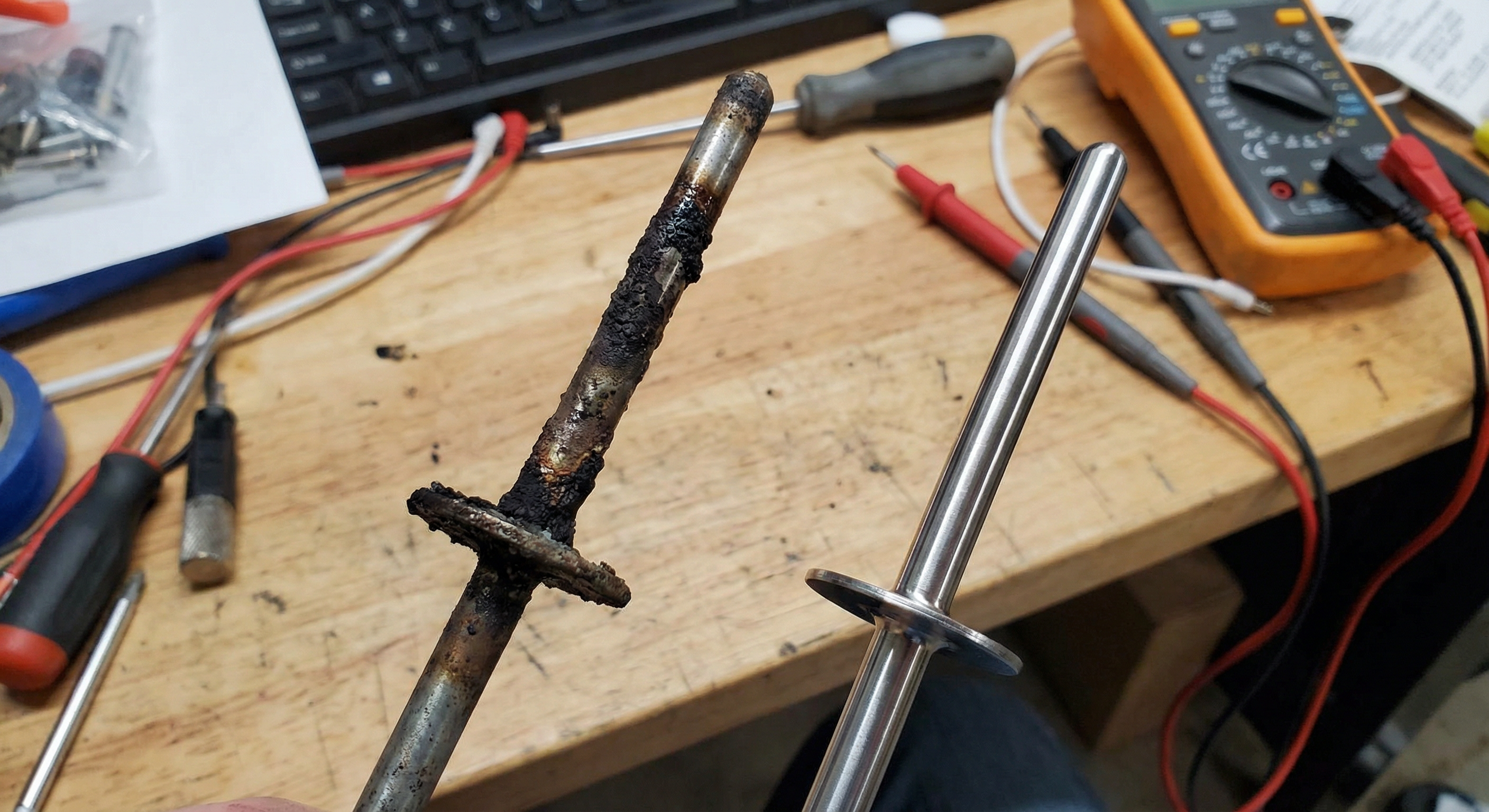
Clean flame sensor (right) vs fouled sensor (left)
How long does furnace repair usually take?
Most repairs (flame sensor, igniter, thermostat, filter) take 30-90 minutes. Complex issues (gas valve, control board, blower motor) can take 2-4 hours. Parts availability is the wild card.
Should I repair or replace my furnace?
Use the $5,000 rule: Age × Repair Cost. If your furnace is 15 years old and needs $400 repair: 15 × $400 = $6,000 → Replace. If 8 years old and needs $300: 8 × $300 = $2,400 → Repair.
Can I run my furnace with a cracked heat exchanger?
Absolutely not. A cracked heat exchanger leaks carbon monoxide – this can cause serious injury or death. Shut down immediately and get it replaced.
Why does my furnace work fine all day but fails at night?
Temperature fluctuations. Furnaces work harder when it’s colder. Components that are “almost failing” often fail under higher load during cold nights.
Is it normal for my furnace to cycle on and off frequently?
No. This is short-cycling. Common causes: oversized furnace, clogged filter, failed limit switch, or bad thermostat placement. Get it diagnosed – short-cycling wastes energy and causes premature wear.
Conclusion
Most furnace failures have simple fixes – thermostat settings, clogged filters, dirty flame sensors, or tripped breakers account for 70% of “no-heat” calls. Before assuming your furnace is dead, check these basics.
At Blue Collar Heating & Air, we provide same-day emergency furnace repairs across Denver metro. We carry common parts on our trucks, provide transparent pricing upfront, and never push unnecessary replacements.
Furnace not working? Call (303) 351-1667 for emergency service. We’ll diagnose the issue and have your heat back on fast – typically within 2-4 hours of your call.