✓ Licensed & Insured ✓ 20+ Years Experience ✓ Same-Day Service ✓ Family Owned

How to Shut Down Your AC for the Season the Right Way

📖 Table of Contents ▾

In This Article

  1. Quick Answer
  2. Why a Proper Shutdown Matters
  3. The Correct Shutdown Steps
  4. Should You Cover Your Outdoor Unit?
  5. Common Mistakes to Avoid
  6. FAQ

Written by Lance Fredrickson — ICC Certified HVAC Specialist | EPA 608 Universal

20+ years serving the Denver metro • Blue Collar Heating & Air, Northglenn CO

Most homeowners “shut down” their AC by simply not touching the thermostat anymore once fall arrives. That’s not wrong, exactly, but it skips a few steps that protect your outdoor unit through a Denver winter — one that can include heavy snow, freeze-thaw cycles, and months of total inactivity. Here’s the proper way to do it.

⚡ Quick Answer: AC Shutdown Checklist

Clean the unit — Remove debris, hose off coils, clear 2 ft around itDIY, free
Cover or not? — Top cover only, never fully wrapOptional
Breaker — Leave on in most cases (protects compressor heater)Leave on
Time required — Full shutdown routine20-30 min

Why a Proper Shutdown Matters in Denver

Your outdoor AC condenser is built to handle outdoor conditions year-round, so it’s not fragile — but Denver throws a few specific challenges at it that make a bit of fall attention worthwhile. Heavy, wet snow can accumulate on top of the unit and, during freeze-thaw cycles, work its way into the cabinet. Debris left against the coils over winter attracts rodents looking for a warm, sheltered spot, and mice chewing through low-voltage control wiring is a surprisingly common spring repair call.

The Correct Shutdown Steps

1. Final Cleaning

Hose down the condenser coils (the fins around the sides of the unit) to remove any accumulated dust, cottonwood fluff, or grass clippings. A clean unit going into winter means less debris trapped under snow and ice.

2. Clear the Area

Trim back any plants or shrubs to maintain at least 2 feet of clearance on all sides. This matters even more in winter — snow shoveled or blown off a driveway often gets piled near the unit, and you want clear ground so that pile doesn’t bury the whole condenser.

3. Decide on a Cover

This is the most debated step — more on it below.

4. Leave the Breaker On (Usually)

Many homeowners assume they should flip the breaker off to “save power” over winter. In most modern systems, we actually recommend leaving it on. Many compressors have a small internal crankcase heater that keeps oil warm and prevents refrigerant from pooling in the compressor during cold weather — cutting power to this heater can cause compressor damage when you start the system back up in spring. If you’re unsure whether your system has one, leaving the breaker on is the safer default.

5. Don’t Disconnect Anything

There’s no need to disconnect refrigerant lines, electrical connections, or anything else. Your AC system is a sealed, weatherproof unit designed to sit outside through winter without being “unplugged” in any meaningful sense.

Should You Cover Your Outdoor AC Unit?

This is genuinely the most common question we get every October, and the honest answer is: a partial top cover, yes; a full wrap, no.

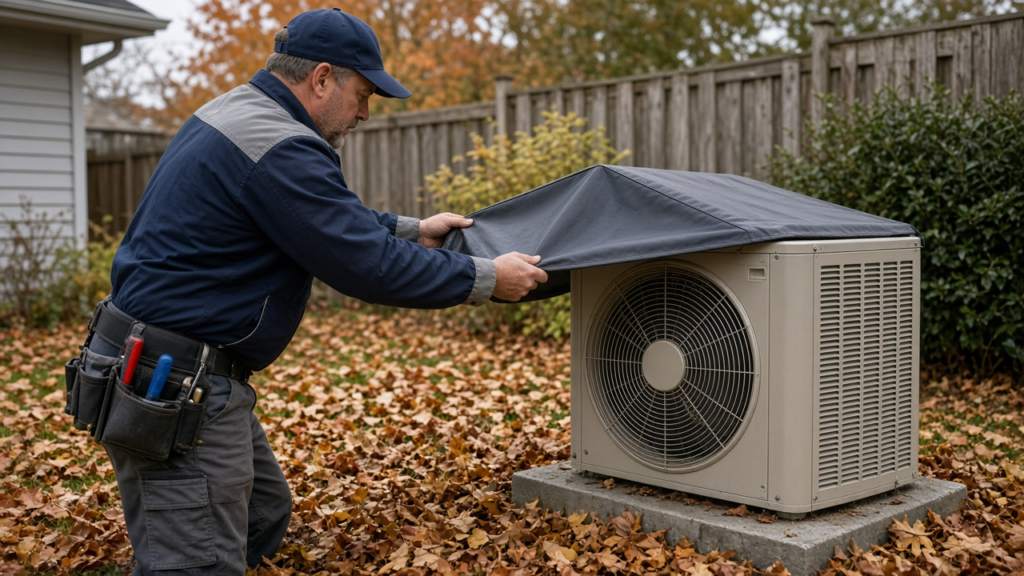
Never fully wrap your AC unit in plastic or a tarp that seals the sides. Condensation builds up inside a fully sealed cover, and that trapped moisture promotes rust on internal components and can attract rodents looking for a dry, enclosed space to nest. We see more unit damage from over-covering than from leaving units completely exposed.

A better approach, if you want some protection, is a flat top cover that shields just the top of the unit from falling debris and heavy snow accumulation while leaving the sides open for airflow. Several manufacturers sell purpose-built top covers for $20-$40 that do exactly this without trapping moisture.

Common Shutdown Mistakes to Avoid

  • Fully wrapping the unit in plastic or a tarp (traps moisture, invites rodents)
  • Turning off the breaker on a system with a crankcase heater
  • Leaving debris or leaves piled against the unit all winter
  • Letting snow-shoveling piles bury the condenser
  • Forgetting to do a final hose-down while the coils are accessible
  • Real Job: Arvada, Spring 2025

    A homeowner in Arvada had fully wrapped their AC unit in a plastic tarp every winter for years “to protect it.” When we came out for a spring start-up check, we found significant rust on the internal fan motor housing and evidence that mice had been nesting inside — they’d chewed through the low-voltage thermostat wire. The repair, including a new contactor and rewiring the control circuit, ran about $380. We switched them to a simple top-only cover, and the following winter showed no issues.


    Ready to Fix Your HVAC Issue?

    Call Blue Collar Heating & Air for expert service in the Denver Metro area. Same-day appointments available.

    ✓ Licensed & Insured ✓ 20+ Years Experience ✓ Transparent Pricing

    Frequently Asked Questions

    Should I turn off the breaker to my AC unit for winter?

    In most cases, no. Many compressors have a crankcase heater that needs continuous power to keep refrigerant oil warm through winter. Cutting power can cause compressor damage when the system restarts in spring. Leave the breaker on unless a technician has told you otherwise for your specific system.

    Is it OK to fully cover my AC unit with a tarp for winter?

    We don’t recommend it. Fully sealed covers trap moisture, which promotes rust and creates an attractive dry shelter for rodents. A partial top-only cover offers protection from snow and debris without sealing the unit.

    Do I need to disconnect anything before winter?

    No. Your outdoor AC unit is a sealed, weatherproof system designed to remain connected and in place through winter without any disassembly.

    What happens if snow piles up on my outdoor unit?

    Light snow on top is generally not harmful, but heavy accumulation combined with freeze-thaw cycles can work moisture into the cabinet over time. Clearing significant snow buildup periodically, and keeping shoveled snow piles away from the unit, is good practice.

    When should I do my end-of-season AC shutdown?

    Any time after you’re confident you won’t need cooling again — typically early-to-mid October in the Denver metro, once overnight lows are consistently dropping and daytime highs rarely exceed the mid-70s.


    Free estimates • Licensed & Insured • ICC Certified

    Table of Contents

    Family-Owned, Community-Trusted

    Verified On

    Not ready to call? We'll reach out to you.

    Fill out the form and we'll get back to you as soon as possible during business hours. Free quote, no obligation.

    Family Owned Licensed & Insured Same-Day Service

      Call Now Schedule