
✓ Licensed & Insured ✓ 20+ Years Experience ✓ Same-Day Service ✓ Family Owned

How to Test Your Furnace’s Flame Sensor

📖 Table of Contents ▾

In This Article

  1. Quick Answer
  2. What a Flame Sensor Actually Does
  3. Signs Your Flame Sensor Is Failing
  4. How a Flame Sensor Is Tested and Cleaned
  5. Should You Attempt This Yourself?
  6. FAQ

Written by Lance Fredrickson — ICC Certified HVAC Specialist | EPA 608 Universal

20+ years serving the Denver metro • Blue Collar Heating & Air, Northglenn CO

If your furnace ignites for a few seconds, then shuts back off, then tries to ignite again in a repeating pattern, there’s a very good chance the culprit is a dirty or failing flame sensor. This is genuinely one of the most common furnace repairs we perform every fall and winter in the Denver metro — and understanding how it works helps explain why.

⚡ Quick Answer: Flame Sensor Basics

What it does — Confirms the burner flame is actually litSafety device
Main failure mode — Carbon/corrosion buildup on the sensor rodVery common
Professional cleaning — As part of a tune-up or standalone visit$95–$150
Replacement (if needed) — Sensor itself is inexpensive$100–$200 installed

What a Flame Sensor Actually Does

A flame sensor is a thin metal rod, usually located just behind the burner assembly, that serves a single critical safety function: confirming that the burner has actually ignited before allowing the gas valve to stay open. It works via a principle called “flame rectification” — when the sensor is in contact with an actual flame, it generates a tiny electrical signal that the control board reads as “yes, there is fire here.” No signal means no confirmed flame, and the control board shuts the gas valve as a safety measure within seconds.

This is a critical safety system, not a minor component — without it, gas could theoretically continue flowing into the combustion chamber even if ignition failed, which is a real hazard. The flame sensor’s job is to prevent exactly that scenario.

Signs Your Flame Sensor Is Failing

  • Furnace ignites, runs for a few seconds to a minute, then shuts off
  • The ignition sequence repeats itself multiple times (burner tries, fails, tries again)
  • Furnace eventually locks out after several failed attempts, requiring a thermostat reset
  • Problem is intermittent at first, then becomes more frequent and consistent over days or weeks
  • Problem often gets worse the longer the furnace has been running that heating season (more buildup accumulates)
  • This failure pattern — “short cycling” specifically tied to brief ignition followed by shutoff — is different from a furnace that won’t ignite at all (which more often points to the igniter itself, the gas valve, or a control board issue). A flame sensor problem is specifically “it lights, but then thinks it didn’t, and shuts off.”

    How a Flame Sensor Is Tested and Cleaned

    A technician tests a flame sensor using a microamp meter connected in-line with the sensor wire while the furnace is running. A healthy flame sensor typically produces a reading in the 2-6 microamp range (exact spec varies by manufacturer); a reading below roughly 1-2 microamps usually indicates the sensor isn’t reading the flame reliably and needs cleaning or replacement.

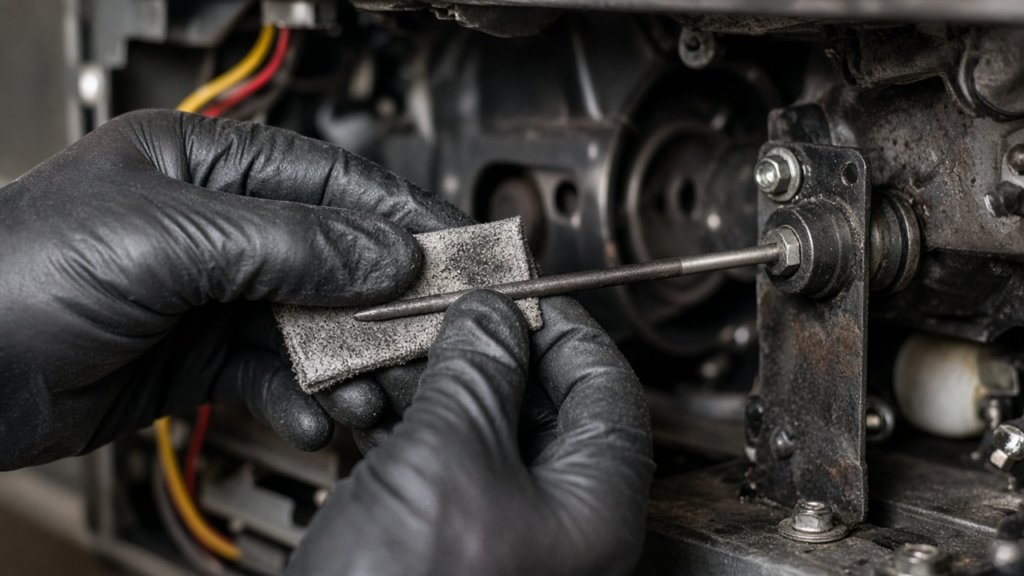
    Cleaning involves removing the sensor (usually one or two screws), gently cleaning the carbon/corrosion buildup off the metal rod with fine emery cloth or steel wool (not sandpaper, which can leave an insulating residue), reinstalling it, and retesting. In most cases, cleaning alone restores normal function. If the sensor still reads low after cleaning, or shows physical damage/cracking in the ceramic insulator, replacement is the next step — the part itself is inexpensive, typically $20-$40, with labor bringing a full replacement to $100-$200.

    Should You Attempt This Yourself?

    Flame sensor cleaning is one of the more DIY-approachable furnace repairs, if you’re comfortable safely accessing the burner compartment and know your specific furnace model’s sensor location. That said, there are a few reasons many homeowners still call a professional for this specific repair:

    Things that go wrong with DIY flame sensor attempts: Using sandpaper or an abrasive that’s too coarse (scratches can actually make buildup worse over time), reinstalling the sensor with an incorrect gap from the flame, not properly shutting off gas and power before accessing the burner compartment, or missing a separate underlying issue (like a gas pressure problem) that’s actually causing accelerated buildup in the first place.

    If you do want to attempt it: turn off power to the furnace at the switch and shut the gas valve, locate the sensor (consult your furnace’s manual — it’s usually a thin rod near the burners with a single wire connector), remove it carefully, clean gently, and reinstall snugly but without overtightening. If you’re not confident in any part of this process, it’s a quick and inexpensive professional visit.


    This is exactly the kind of issue a fall tune-up catches proactively. Flame sensor cleaning is a standard part of our fall furnace tune-up checklist specifically because buildup happens gradually over a heating season and is easy to address before it causes a lockout.

    Ready to Fix Your HVAC Issue?

    Call Blue Collar Heating & Air for expert service in the Denver Metro area. Same-day appointments available.

    ✓ Licensed & Insured ✓ 20+ Years Experience ✓ Transparent Pricing

    Frequently Asked Questions

    What does a bad flame sensor actually do to my furnace?

    It causes the furnace to ignite briefly and then shut back off, because the sensor can’t reliably detect the flame through carbon or corrosion buildup. The furnace may repeat this cycle several times before locking out entirely.

    Can I clean my furnace’s flame sensor myself?

    It’s one of the more DIY-approachable furnace repairs if you’re comfortable safely accessing the burner compartment after shutting off gas and power. Use fine emery cloth, not sandpaper, and reinstall carefully. If unsure, it’s an inexpensive professional visit.

    How much does flame sensor cleaning or replacement cost?

    Professional cleaning typically runs $95-$150. If replacement is needed, the part itself is inexpensive ($20-$40), with full replacement including labor running $100-$200.

    Why does my furnace’s flame sensor get dirty in the first place?

    Over a heating season, combustion byproducts gradually deposit a thin carbon layer on the sensor rod, which insulates it from properly reading the flame. This is a normal wear pattern, not a sign of a defective part.

    Is a flame sensor the same as a pilot light?

    No. A pilot light is a small continuously-burning flame found in older furnaces. A flame sensor is a safety detection rod found in modern furnaces with electronic ignition, used to confirm the main burner flame is lit before allowing continued gas flow.


    Free estimates • Licensed & Insured • ICC Certified

    Table of Contents

    Family-Owned, Community-Trusted

    Verified On

    Not ready to call? We'll reach out to you.

    Fill out the form and we'll get back to you as soon as possible during business hours. Free quote, no obligation.

    Family Owned Licensed & Insured Same-Day Service

      Call Now Schedule