
✓ Licensed & Insured ✓ 20+ Years Experience ✓ Same-Day Service ✓ Family Owned

What Size Furnace Do I Need for My Denver Home?

📖 Table of Contents ▾

In This Article

  1. Quick Answer
  2. Why Sizing Matters So Much
  3. How Proper Sizing Actually Works
  4. Denver’s Altitude Derating Factor
  5. Signs Your Furnace Is the Wrong Size
  6. FAQ

Written by Lance Fredrickson — ICC Certified HVAC Specialist | EPA 608 Universal

20+ years serving the Denver metro • Blue Collar Heating & Air, Northglenn CO

“Just match what’s already there” is the single most common (and most flawed) approach to furnace replacement sizing. A lot of furnaces were oversized to begin with, and simply duplicating that mistake on a replacement locks in the same short cycling, uneven heat, and efficiency problems for another 15-20 years. Here’s how sizing actually should work.

⚡ Quick Answer: Furnace Sizing

Correct method — Manual J load calculation, not square footage rule of thumbRequired
Typical Denver home (2,000 sq ft) — Rough BTU range, highly variable60,000–90,000 BTU
Altitude adjustment — Output derates roughly 4% per 1,000 ft above sea level~20% at 5,280 ft
Load calculation cost — Often included free with a replacement quoteUsually $0

Why Sizing Matters So Much

An oversized furnace heats your home quickly, then shuts off, then the house cools and it fires back up again shortly after — the short cycling we cover in detail in a separate article. This isn’t just an efficiency problem; constant starting and stopping wears out igniters, blower motors, and gas valves faster, and the rapid cycles never give the system time to properly dehumidify or evenly distribute heat before shutting off.

An undersized furnace faces the opposite problem: it runs nearly constantly during cold weather, struggling to reach the thermostat’s setpoint, which means higher gas bills and a home that never quite feels warm enough on the coldest days.

How Proper Sizing Actually Works

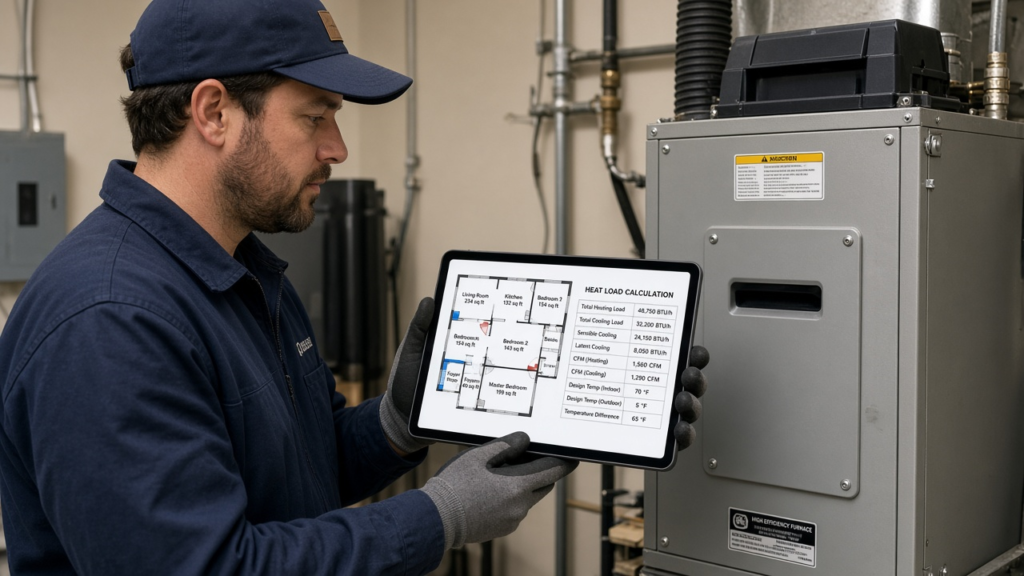
The industry-standard method is a Manual J load calculation, a detailed assessment that accounts for your home’s square footage, insulation levels, window type and area, ceiling height, air leakage, local climate design temperatures, and even which direction the home faces. This produces a specific BTU heating load requirement unique to your home — not a generic “1,500 sq ft = X BTU” rule of thumb, which ignores huge variables like insulation quality and window performance.

Two identical 2,000 sq ft homes can have genuinely different heating loads if one has older single-pane windows and minimal attic insulation while the other has been upgraded with modern windows and R-49 attic insulation. A proper load calculation captures that difference; a square-footage rule of thumb doesn’t.

Be cautious of any contractor who quotes a furnace size without ever discussing your home’s insulation, windows, or doing any kind of load assessment. “Matching what’s there” or quoting purely off square footage is a common shortcut that perpetuates sizing mistakes from the original installation.

Denver’s Altitude Derating Factor

Here’s a genuinely Denver-specific wrinkle: furnace BTU output ratings are based on sea-level combustion. At altitude, with less oxygen-dense air, a furnace’s actual heat output derates — roughly 4% per 1,000 feet of elevation above sea level, which works out to approximately a 20% reduction at Denver’s 5,280 feet compared to its rated sea-level output.

A properly done Denver installation accounts for this derating in the sizing calculation and/or through appropriate gas orifice and manifold pressure adjustments made during installation (the same altitude calibration we cover in our furnace lifespan article). This is a technical detail that’s easy for an inexperienced installer to overlook, and it’s worth specifically asking about if you’re getting quotes for a new furnace.

Signs Your Current Furnace Is the Wrong Size

  • Frequent short cycling (see our dedicated article on this)
  • Uneven temperatures between rooms despite normal ductwork
  • Furnace runs almost constantly during cold snaps and still struggles to maintain setpoint (undersized)
  • Noticeably high humidity or stuffiness, paired with quick temperature recovery (oversized, not running long enough to properly circulate air)
  • Higher-than-expected gas bills relative to home size and insulation quality
  • If you’re noticing several of these and your furnace is approaching replacement age anyway, it’s worth specifically requesting a load calculation as part of your replacement quote rather than assuming the next furnace should simply match the old one’s capacity.


    Most reputable HVAC contractors include a load calculation at no extra charge as part of a furnace replacement estimate. If a quote doesn’t mention one, it’s worth asking directly whether sizing was based on an actual calculation or simply matched to the existing equipment.

    Ready to Fix Your HVAC Issue?

    Call Blue Collar Heating & Air for expert service in the Denver Metro area. Same-day appointments available.

    ✓ Licensed & Insured ✓ 20+ Years Experience ✓ Transparent Pricing

    Frequently Asked Questions

    Can I just match my new furnace to the size of my old one?

    We don’t recommend it without verification. A meaningful share of existing furnace installations were oversized to begin with. A proper Manual J load calculation confirms the correct size for your specific home rather than perpetuating a potential original sizing mistake.

    What is a Manual J load calculation?

    It’s the industry-standard method for determining a home’s exact heating (and cooling) requirements, accounting for square footage, insulation, window type and area, ceiling height, air leakage, and local climate data — producing a specific BTU requirement unique to your home.

    Does Denver’s altitude actually affect furnace sizing?

    Yes. Furnace BTU output ratings are based on sea-level combustion, and actual output derates roughly 4% per 1,000 feet of elevation — about a 20% reduction at Denver’s 5,280 feet. Proper sizing accounts for this derating.

    What size furnace does a typical Denver home need?

    It varies widely based on insulation, windows, and layout, but a common range for a 2,000 sq ft Denver home is roughly 60,000-90,000 BTU. This is only a rough guide — an actual load calculation is the only reliable way to determine your home’s specific requirement.

    Does a load calculation cost extra when getting a furnace replacement quote?

    Most reputable contractors include this as a standard part of a replacement estimate at no additional charge. If a quote doesn’t mention a load calculation, it’s worth asking directly how the proposed furnace size was determined.


    Free estimates • Licensed & Insured • ICC Certified

    Table of Contents

    Family-Owned, Community-Trusted

    Verified On

    Not ready to call? We'll reach out to you.

    Fill out the form and we'll get back to you as soon as possible during business hours. Free quote, no obligation.

    Family Owned Licensed & Insured Same-Day Service

      Call Now Schedule