In This Article
If you’ve lived in Denver more than a year, you know the feeling: 85°F on a Tuesday, 48°F by Thursday morning. That swing creates a genuinely confusing question for homeowners every September and October — when do you actually switch the system from cooling to heating mode, and is there a “wrong” time to do it?
⚡ Quick Answer: AC-to-Heat Timing
Denver’s 40-Degree-Swing Problem
Most climates have a fairly gradual transition from summer to fall. Denver doesn’t. Thanks to our high altitude and distance from any moderating body of water, it’s common to see a 40°F swing between a September afternoon high and the overnight low on the same day. That makes a single “switch day” almost meaningless — you might need AC at 3 PM and heat at 3 AM on the exact same date.
This is actually one of the most common causes of “my furnace won’t turn on” service calls in early fall — not because anything is broken, but because the system was never switched over, or was switched over and never actually tested before the first cold night arrived.
How to Decide When to Switch
Rather than picking a calendar date, use your overnight low temperature as the trigger. Here’s the practical guidance we give Denver homeowners:
In a typical year, this means most Denver metro homes should test their furnace in mid-to-late September and be fully switched over by early October — well before the first hard freeze, which historically lands anywhere from early October to early November depending on the year.
Before You Flip the Switch: A 10-Minute Test
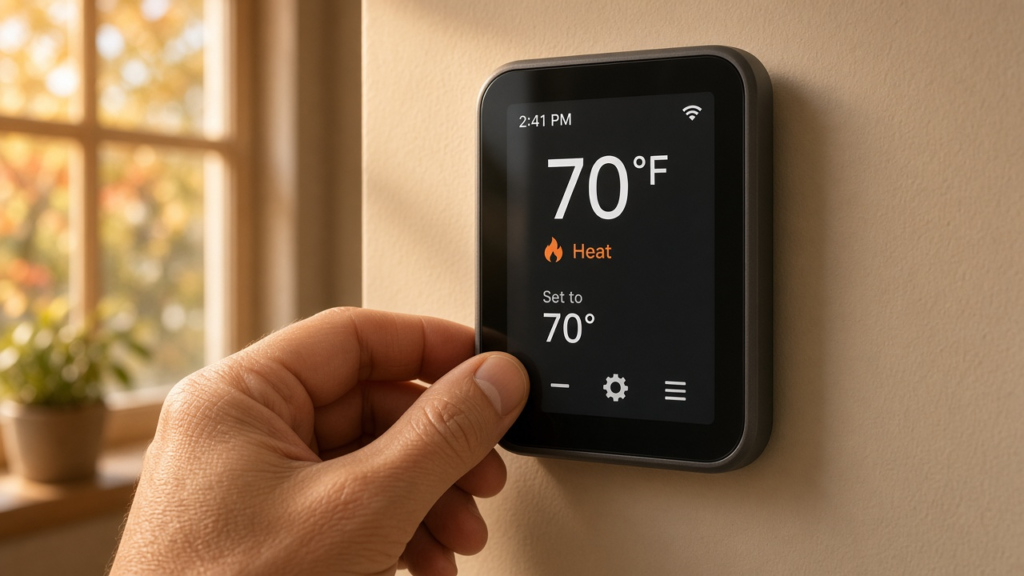
Don’t just bump the thermostat to HEAT and walk away. Do this instead:
- Set the thermostat to HEAT and raise the setpoint 5 degrees above current room temperature
- Listen for the furnace to ignite within 30-60 seconds — you should hear the igniter click, then a soft whoosh as the burners light
- Confirm warm air is coming from the vents within 2-3 minutes
- Let it run a full 10-minute cycle and check that it shuts off properly when the setpoint is reached
If the furnace doesn’t ignite, cycles on and off rapidly, or you smell anything unusual (especially a strong burning smell beyond the normal “dust burning off” smell in the first few minutes), that’s your signal to call for service now, while it’s 70°F outside and not an emergency.
Can You Run AC and Heat the Same Week?
Yes, and it’s completely normal in Denver’s shoulder season. Your thermostat is designed to switch between modes — just not within the same few minutes. Give the system at least 5-10 minutes with the thermostat set to OFF when switching between AC and heat modes to let refrigerant pressures and components settle. On a typical system, this isn’t something you need to actively manage; just avoid rapidly toggling back and forth within the same hour.
One thing worth checking: if you have a single central system without zoning, you can’t run AC and heat simultaneously in different parts of the house — it’s one or the other at any given time. If temperature swings within your own home are a daily frustration during shoulder season, that’s actually a sign zoning might be worth looking into (we cover that in a separate article).