
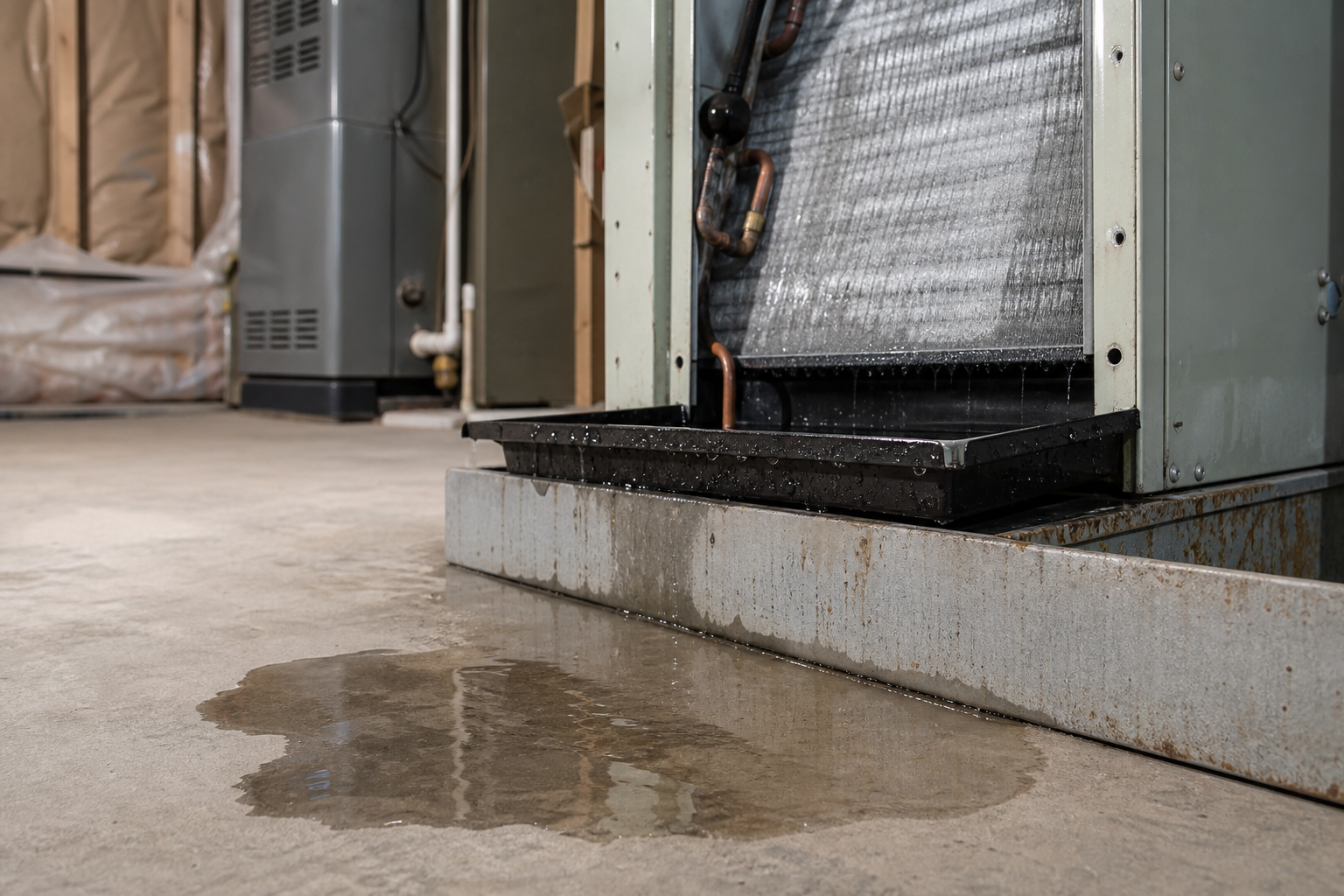
Water pooling near an indoor air handler — one of the most common summer service calls in Denver.
You notice water dripping from your AC unit, or you find a puddle on the floor near your indoor air handler. The carpet is damp, or there’s a suspicious stain spreading across the ceiling below your attic unit. You’re worried about water damage — and rightfully so. A leaking AC left unchecked can soak insulation, rot drywall, and create conditions for mold growth within 24–48 hours.
Before you panic: this is one of the most common service calls we get at Blue Collar Heating & Air all summer long, and the vast majority are fixable in under an hour. In 20+ years serving Denver, I’ve tracked down hundreds of these leaks. The cause is almost always one of five things — and several you can diagnose yourself in the next ten minutes.
⚡ Quick Answer: Why Is My AC Leaking Water Inside?
AC water leaks inside are almost always caused by one of these five problems:
- Clogged condensate drain line — the most common cause (60% of cases). Cost to clear: $125–$175.
- Frozen evaporator coil thawing — caused by a dirty filter or low refrigerant. Free DIY fix (filter) or $400–$600 (refrigerant).
- Cracked or rusted drain pan — common in older units. Replacement: $100–$275.
- Disconnected or loose drain line — an easy free fix you can do yourself in 2 minutes.
- Low refrigerant causing freeze/thaw cycles — requires EPA-certified technician. $400–$600.
First step right now: Turn off the AC at the thermostat, locate the source of the water, and check your air filter. If it’s gray or black, replace it before you do anything else.
How Your AC Creates Water (And Why It Leaks)
Your air conditioner doesn’t just cool air — it also removes humidity from it. That’s the dehumidification function most people don’t think about. Here’s what happens inside your system every time it runs:
Warm, humid air from your home passes over the evaporator coil — a cold metal coil inside your air handler. The cold surface causes moisture in the air to condense, exactly the way a cold glass “sweats” on a hot day. That condensed water drips down into the drain pan below the coil, then exits your home through the condensate drain line — typically a white PVC pipe that empties into a floor drain, outside, or into your plumbing.
When any part of this system fails — the coil gets too cold and freezes, the pan cracks, the drain line clogs — water has nowhere to go except out onto your floor, into your walls, or down through your ceiling. Denver’s relatively dry climate (indoor humidity averages 20–40% in summer) means you generate less condensate than a homeowner in Florida or Texas. But during our July–August monsoon season, when humidity spikes to 60–70%, condensate volume can triple — and that’s exactly when a partially clogged drain line becomes a flood.

The condensate path: evaporator coil → drain pan → condensate line. A failure at any point causes water to back up into your home.
The 5 Most Common Causes of AC Water Leaks
Clogged Condensate Drain Line (60% of Cases)
This is the culprit in roughly 6 out of 10 AC water leak calls we respond to. The condensate drain line is a dark, moist pipe — exactly the kind of environment that algae, mold, and dust love to colonize. Over months and years, this organic growth accumulates until the drain narrows or blocks completely. Water backs up into the drain pan, overflows the edges, and ends up on your floor.
Denver’s dry climate actually means fewer clogs than humid markets like Houston or Atlanta — but our July–August monsoon season is the exception. When outdoor humidity spikes from 25% to 65% over a few days, your system generates dramatically more condensate than it does on a typical dry summer day. A drain line with even a partial blockage will overflow during these weather events, which is why we get so many drain-line calls in late July and early August.
Signs of a clogged condensate drain line:
- Puddle near the air handler or furnace cabinet
- AC shuts off by itself — the safety float switch has been triggered
- Musty smell from vents (standing water in drain pan = mold)
- Water stain on ceiling directly below attic unit
✓ Can You DIY This?
Yes — for mild clogs. Locate the condensate drain access port (a small cap on the PVC pipe near your air handler). Pour one cup of diluted bleach (1 part bleach to 16 parts water) or distilled white vinegar down the line. Wait 30 minutes, then flush with water. You can also use a wet/dry shop vac at the outdoor drain opening to suck out the clog. Call us if water continues overflowing — a severely blocked line needs professional clearing and treatment to prevent recurrence.
Professional clearing cost: $125–$175. We flush the line, apply an algaecide treatment, and test flow. Same-day service available 7 days a week.
Frozen Evaporator Coil Thawing
When airflow over the evaporator coil is restricted — usually by a clogged air filter — or when refrigerant is too low, the coil temperature can drop below 32°F and ice forms on its surface. Your AC keeps running, the ice builds up, and then either a safety switch shuts the system down or you turn it off yourself because it stopped cooling. When the unit shuts down, the accumulated ice melts all at once, releasing far more water than your drain pan can handle in a short time.
Signs of a frozen coil leak:
- AC was blowing warm or cool-but-not-cold air before the leak appeared
- Visible frost or ice on the refrigerant lines (copper pipes with black foam insulation)
- Dramatic water release 30–60 minutes after turning off the AC
- AC runs constantly but can’t reach the set temperature
⚠️ Important: Turn Off Your AC Immediately
If you can see ice on the copper refrigerant lines or on the coil itself, turn your AC off at the thermostat right now. Switch the fan to ON so it continues running — the fan will help melt the ice faster without the compressor running. Running a frozen compressor causes expensive damage. Let the coil thaw completely (2–4 hours) before turning cooling back on.
Fix depends on the cause:
- Dirty filter (most common): Replace the filter immediately. This is a free DIY fix. Wait for the coil to thaw, replace the filter, and restart. If the system cools properly, you’re done.
- Low refrigerant: Call a professional. Requires EPA 608 certification. Cost: $400–$600 for leak detection, repair, and recharge.
Cracked or Rusted Drain Pan
Your AC system has two drain pans: a primary pan directly below the evaporator coil (usually plastic), and a secondary overflow pan below that (often sheet metal). In units 10 years or older, the primary plastic pan can develop hairline cracks as it expands and contracts with temperature changes. The sheet metal secondary pan can develop rust holes, especially in homes where condensate water has been sitting in it (indicating a preexisting drain clog).
Denver’s altitude adds a factor that most people don’t realize: we receive 20–30% more UV radiation per square mile than sea-level cities. While UV doesn’t directly reach indoor drain pans, the heat it generates affects the entire system, accelerating the expansion/contraction cycles that crack plastic components over time.
Signs of a failed drain pan:
- Water leaking from unit even when condensate drain line is clear and flowing
- Visible rust streaks or discoloration on the outside of the air handler cabinet
- Water directly below the unit (not tracking along a line to a drain)
Fix: Temporary patch with waterproof epoxy or HVAC-rated sealant can buy time, but the correct repair is pan replacement. Cost: $100–$275 depending on pan size and accessibility. Schedule sooner rather than later — a cracked pan that fails fully can release significant water quickly.
Disconnected or Loose Drain Line
The condensate drain line connects to the drain pan fitting with a slip coupling or a hose clamp. During filter changes, attic access, or routine maintenance, it’s surprisingly easy to bump this connection loose — especially in tight spaces where the air handler is awkward to reach. A fully disconnected line pours condensate directly onto the floor; a partially loose connection drips more slowly.
Signs of a disconnected drain line:
- Water pooling immediately and noticeably — not gradual buildup
- Happened shortly after a filter change or service visit
- Drain line visibly dangling or not fully inserted into the pan fitting
✓ Check This First — Takes 2 Minutes
Turn off the AC. Find where the PVC drain line attaches to your air handler. Push the pipe firmly into the fitting — it should seat with a slight click or feel snug. If there’s a clamp, tighten it with a screwdriver. Turn the AC back on and watch for leaking. This is a completely free DIY fix.
Low Refrigerant Causing Freeze/Thaw Cycles
Your AC system is a sealed refrigerant loop — it doesn’t “use up” refrigerant the way a car uses gas. If refrigerant is low, there’s a leak somewhere in the system. Low refrigerant causes the evaporator coil to run at abnormally low temperatures, forming ice. The compressor keeps running, the coil keeps freezing, and each thaw cycle dumps water the drain pan can’t absorb fast enough. This creates a repeating leak pattern: water appears, AC eventually re-freezes, water stops temporarily, then the thaw cycle starts again.
Signs of low refrigerant:
- AC runs continuously but cannot reach set temperature
- Ice visible on the copper refrigerant lines outdoors or on the indoor coil
- Hissing or bubbling sound from refrigerant lines
- Recurring leak pattern — not a one-time event
- Higher electric bills with reduced cooling effectiveness
🚫 Cannot DIY — EPA Certification Required
Refrigerant work requires an EPA 608 Universal certification. Purchasing refrigerant without certification is illegal under federal law. Additionally, simply adding refrigerant without finding and repairing the leak is a short-term fix — the leak will continue. A proper repair includes leak detection, pressure testing, leak repair, and recharge. Lance holds EPA 608 Universal certification. Cost: $400–$600.
AC Water Leak Repair Costs in Denver
| Problem | DIY Possible? | Professional Cost |
|---|---|---|
| Clogged condensate drain line | Mild clogs, yes | $125–$175 |
| Frozen coil — dirty filter | Yes (replace filter) | Free (DIY) |
| Frozen coil — low refrigerant | No | $400–$600 |
| Cracked or rusted drain pan | Temporary patch only | $100–$275 |
| Disconnected drain line | Yes (2-minute fix) | Free (DIY) |
| Emergency same-day service surcharge | — | +$100–$150 |
Denver-Specific Factors That Make AC Leaks More Likely
In 20+ years working HVAC at 5,280 feet, I’ve noticed patterns that are specific to Denver homeowners. Our climate creates conditions that directly affect condensate volume and drain line health.
The July–August Monsoon Season
Denver’s Front Range experiences an annual monsoon pattern each July and August, when moisture flows north from the Gulf of Mexico and the Gulf of California. During this period, outdoor humidity regularly spikes from our typical 20–35% up to 60–70% or even higher. Your AC system removes all of that moisture from the air inside your home — and the condensate volume can triple compared to a typical dry Denver summer day. This is our busiest stretch of the year for drain line overflow calls. A drain line that’s been partially narrowed by algae growth all season handles normal condensate just fine — until monsoon season hits and suddenly the volume exceeds what the line can pass.
Denver Monsoon Season Alert
Denver’s July–August monsoon season can triple condensate volume in your AC system. A partially clogged drain line that’s been “fine all summer” frequently overflows for the first time during these high-humidity weather events. Preventive drain line treatment in May or June can prevent a flooded utility room in August.
Altitude and UV Exposure
At 5,280 feet, Denver receives significantly more UV radiation than sea-level cities. While this primarily affects outdoor components (capacitors, contactors, wiring insulation), the broader climate picture matters: Denver homes are often aggressively air-conditioned because the intense sun heats them rapidly. More cooling run time = more condensate generated = more stress on the drain system over time.
Dry Climate Creates False Security
Because Denver is generally dry, many homeowners assume their AC barely produces any condensate — and they neglect drain line maintenance. The reality is that on humid days (and during monsoon season), your system can produce a gallon or more of condensate per hour. Skipping the annual drain line treatment is a gamble that usually pays off in dry years and fails dramatically in wet ones.
DIY Checks You Can Do Right Now
Before calling us, run through this checklist. Many AC water leaks can be confirmed — and sometimes fixed — without any tools.
- Turn off your AC at the thermostat — set it to OFF (not just Fan, but full OFF). This prevents more ice from forming if the coil is frozen and stops additional water from flowing.
- Check your air filter immediately. Pull it out and look at it. If it’s gray, dark, or visibly clogged with dust and debris, replace it right now before doing anything else. A clogged filter is the single most common cause of frozen coils.
- Locate the condensate drain line — look for a white PVC pipe (usually ¾” diameter) coming out of your air handler cabinet. It typically runs down and exits through a wall, into a floor drain, or toward the exterior of your home.
- Pour diluted bleach or vinegar down the drain access port (the capped T-fitting on the PVC pipe near your air handler). Use 1 cup of distilled white vinegar or a 1:16 bleach/water mix. Wait 30 minutes, then flush with plain water.
- Inspect the drain pan — with a flashlight, look inside the air handler cabinet at the pan beneath the coil. Check for visible cracks, rust holes, or standing water that isn’t draining.
- Look at the copper refrigerant lines — the pipes with black foam insulation. If you can see frost or ice on the insulation or on the coil itself through the access panel, a frozen coil is your problem.
- Check where the drain line connects to the pan — is the PVC pipe fully seated in the fitting? Push it in firmly and check for clamps.

The condensate drain access port (capped T-fitting) is where you pour the cleaning solution. Located on the PVC pipe near your indoor air handler.
When to Call a Professional Immediately
The DIY checks above will handle a significant portion of AC water leaks. But some situations require a professional — either because the repair is beyond DIY scope, or because the risk of delay is too high.
Call us immediately if any of these apply:
- Water is leaking near your electrical panel, junction boxes, or outlets — this is a safety emergency
- Ceiling tiles, drywall, or insulation are visibly water-stained (indicates the leak has been ongoing)
- You can hear dripping inside walls or above the ceiling
- Refrigerant lines have visible ice on them — your coil is frozen and the cause needs diagnosis
- Your AC isn’t cooling effectively in addition to leaking — this suggests a system problem, not just a drain clog
- You’ve poured bleach/vinegar and the water continues to back up — the clog is beyond DIY clearing
- The leak has been occurring for more than a day without being addressed (mold risk)
Our Drain Line Service: $125–$175
(303) 351-1667 • Serving Northglenn, Thornton, Westminster, Broomfield, Brighton, Firestone, Dacono, Arvada
Ready to Fix Your HVAC Issue?
Call Blue Collar Heating & Air for expert service in the Denver Metro area. Same-day appointments available.
Frequently Asked Questions
Turn it off first and check for ice on the refrigerant lines. If the evaporator coil is frozen, continuing to run the AC will worsen the problem — the compressor runs against a blockage, accelerating wear and potentially causing permanent compressor damage. If the coil is frozen, turn the system off and let it thaw completely (2–4 hours) before restarting.
If there is no ice on the lines and the issue is simply a clogged drain line, you can technically run the AC briefly — but water will continue overflowing the drain pan. The risk is water damage to drywall, flooring, insulation, and the air handler cabinet itself. It’s always better to address the source rather than run it and hope.
Three habits cover most AC water leaks: (1) Change your air filter every 60 days (every 30 days during heavy summer use in Denver — dirty filters are the leading cause of frozen coils). (2) Pour one cup of diluted bleach or distilled white vinegar down the condensate drain access port once a month during cooling season to prevent algae and mold buildup. (3) Schedule an annual AC tune-up in April or May — we inspect and flush the drain line, check the drain pan condition, and verify refrigerant pressure before the season gets critical.
It depends on the cause:
- Clogged drain line clearing: $125–$175
- Drain pan replacement: $100–$275 depending on pan size and accessibility
- Refrigerant leak repair and recharge: $400–$600
- Emergency same-day premium surcharge: add $100–$150
- DIY fixes (dirty filter, disconnected drain line): Free to $30 for a new filter
Usually algae or mold has finally blocked enough of the condensate drain line to cause overflow. This buildup happens slowly and silently — the line narrows a bit more each season, passing condensate just fine during normal dry weather. Then Denver’s July–August monsoon season hits, humidity jumps to 60–70%, your system generates three times the normal condensate volume, and a partially blocked drain that was “fine all summer” suddenly overflows. Annual drain line treatment (a simple bleach flush) prevents this entirely. Age also plays a role — drain pans that have held up fine for 10 years can develop hairline cracks that weren’t there the prior season.
Yes — and it can happen faster than most homeowners expect. Water sitting near drywall, insulation, carpet backing, or wood framing creates ideal mold conditions. Mold can begin colonizing within 24–48 hours in the right temperature range. If your AC has been leaking for more than a day or two, visually inspect the surrounding area: look for dark spots on drywall, musty odors, or soft/discolored spots on ceiling tiles. If you find mold growth, address it before restarting the AC — and dry the area thoroughly with fans before closing it back up. We can recommend professional mold remediation companies if needed.
Northglenn • Thornton • Westminster • Broomfield • Brighton • Firestone • Dacono • Arvada